
This isn't a buyer's guide to inflatable movie screens themselves — our sourcing guide for commercial inflatable movie screens covers screen selection. This one is about running the event itself: sizing the screen to your crowd, getting the audio right, and handling concessions without the whole night turning into a logistics headache.
The general rule for outdoor screen sizing is that the farthest viewer shouldn't sit more than roughly 6-8 times the screen's diagonal height away and still get a comfortable viewing experience — a 16ft screen supports a viewing depth of around 100-130ft comfortably, while a 20-24ft screen extends that to 150-190ft. If your typical crowd spreads out further than that behind the front rows, undersizing the screen for the actual footprint is the most common reason outdoor movie nights get complaints about "not being able to see," not the screen brand or projector quality.
A single large speaker stack at the screen creates uneven coverage — loud and distorted up front, inaudible at the back — while a distributed system with speakers spaced through the seating area gives even coverage at lower peak volume, which also reduces noise complaints from neighboring properties. FM transmitter setups (broadcasting audio to attendees' car radios) are a low-cost, zero-noise-complaint alternative that works particularly well for larger municipal or drive-in-style events, though they require attendees to have a working car radio or portable FM receiver.
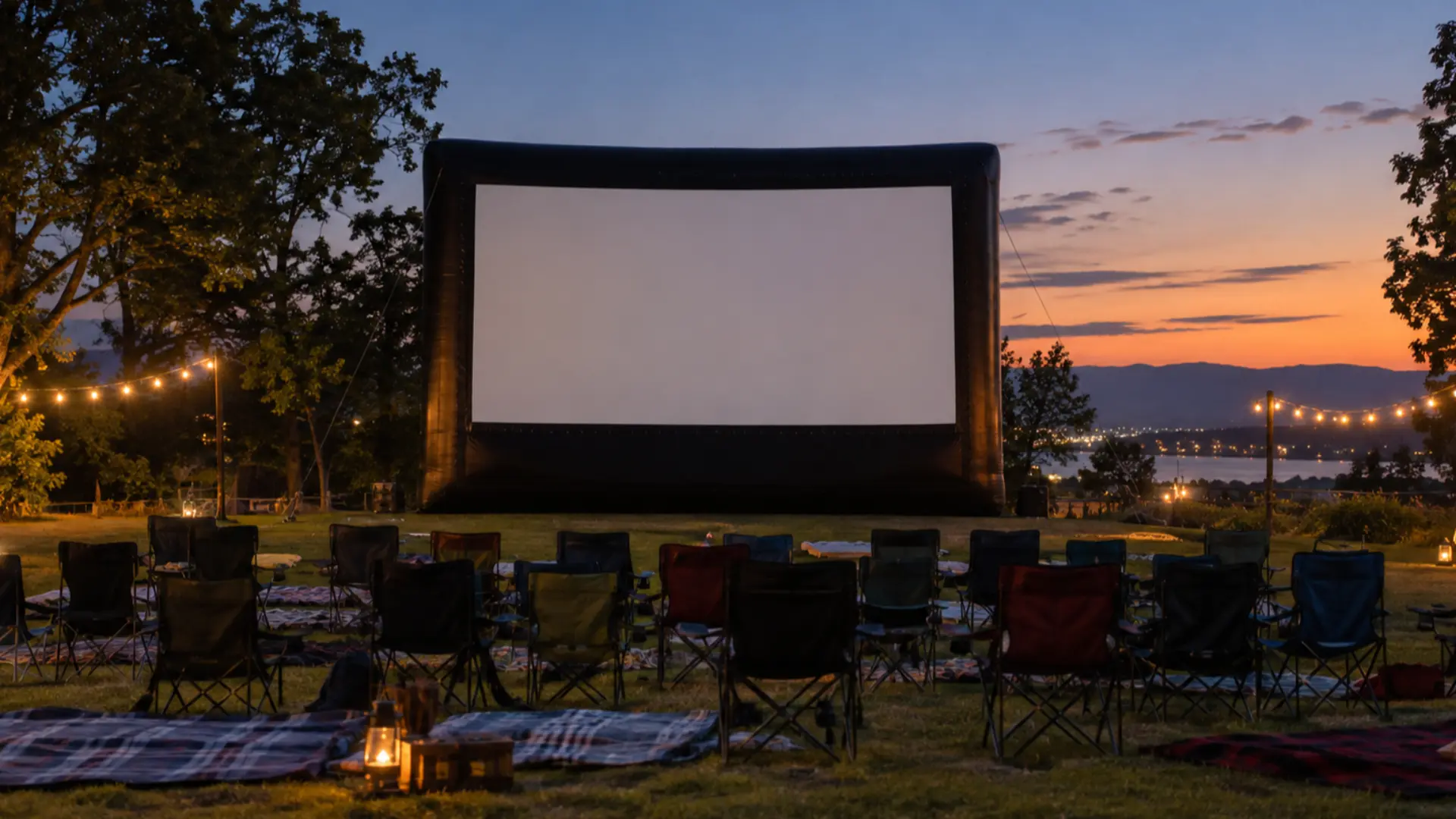
Position concessions to the side or behind the seating area, never between the crowd and the screen, and leave enough queue space that a concessions line doesn't spill into walking paths or block sightlines during the film. A simple pre-order or token system speeds up service more than menu variety does — most outdoor movie night complaints about concessions are about wait time, not selection. If your event includes a shade or shelter structure for the concessions area, our promotional and event tent guide covers sizing options that work well alongside an inflatable screen setup.
Wind is the primary weather risk for an inflatable screen, not rain — most inflatable screens have a rated maximum wind speed, and exceeding it risks both the screen and viewer safety, so a clear go/no-go wind threshold with a named decision-maker should be set before the event, not decided in the moment. Have a rain-date or indoor-backup plan communicated in advance rather than announced the day of, since last-minute cancellations without a stated backup plan generate far more complaints than a rescheduled date announced ahead of time.
Public outdoor screenings of commercially released films generally require a public performance license regardless of whether admission is charged — this is separate from equipment sourcing entirely, but it's worth flagging since municipal and community organizers sometimes learn about the licensing requirement only after the equipment is already booked. Confirm licensing before finalizing your date, not after.
A one-off event usually rents equipment for a single night, while cities and community organizations running a recurring summer movie series often find it more economical to own the screen outright after 3-4 events, similar to the ownership-versus-rental math covered in other event-equipment categories. If you're planning a recurring series, ask your supplier about volume-based options rather than repeating a single-event rental rate each time. Our MOQ reality check by category gives a sense of where the ownership-vs-rental math typically shifts for event equipment.
If your movie night is run through a city parks department or community organization, the same procurement, insurance, and accessibility requirements that apply to other public inflatable installations apply here too — a screen at the front of a seated crowd needs the same clear sightline and accessible-seating planning as any other public event fixture. Confirm insurance and accessibility requirements with your specific program administrator early, since these requirements shape screen placement and seating layout as much as audio and concessions do. See our municipal parks procurement guide for the full insurance and ADA framework most city programs work within.
What screen size works for a typical neighborhood movie night of 100-200 people?
A 16-20ft screen comfortably covers that crowd size at a reasonable viewing distance, assuming seating is arranged in a fan pattern rather than a single long, narrow block extending far past the screen's effective viewing depth.
Can an inflatable screen be used indoors as a rain backup?
Yes, most inflatable screens work indoors in a gym or large hall, though you'll need enough ceiling height and floor space to match the screen's footprint, and you lose the wind-risk factor entirely, which simplifies indoor backup planning.
How far in advance should audio and concessions vendors be booked for a summer series?
For a recurring series, book the full season's dates at once if possible — audio and concessions vendors often give better rates for a season commitment than for individual event bookings, and it avoids the scramble of re-booking before every single date.
Planning a movie night or a full summer series? Share your expected crowd size and venue with our team for a screen and setup recommendation sized to your event.