
Outdoor cinema has turned into one of the most reliable revenue lines in the event rental business. Community movie nights, corporate lawn screenings, pop-up drive-ins and resort poolside films all need the same core asset: a large, portable screen that goes up fast and reads clearly after dark. The inflatable movie screen answers that better than any rigid truss frame, because a blower and a set of stakes replace an hour of scaffolding. This guide covers what actually matters when you source one for commercial use.
An inflatable movie screen is a sealed or blower-fed air frame that holds a projection surface taut. The category splits along three axes that decide price, image quality and handling.
Screen width drives everything. A 16 ft wide unit suits backyard-scale community nights and small corporate lawns. A 20–24 ft screen covers most park and school-field crowds. For drive-in movie screen setups and large festivals you move into 30–40 ft widths, where the projection throw, blower capacity and anchoring all scale up with the fabric. Match the screen to the crowd depth, not just the headcount — a wider screen keeps the back rows legible.
Front projection puts the projector behind the audience and bounces light off the screen face; it is brighter, cheaper and the default for most rentals. Rear projection places the projector behind a translucent screen, which hides the equipment and stops audience shadows — valuable for tight venues and branded stage work, but it demands a darker surrounding and higher lumens. Many commercial screens ship with a removable surface so one air frame runs both modes.
A continuous-blower frame runs a quiet fan the whole show; it tolerates small leaks and holds shape in gusts, which is why most rental fleets prefer it. A fully air-sealed frame needs no running blower but must be pumped and monitored. The trade-offs mirror the wider debate we cover in air-sealed vs metal-frame inflatable structures — pick the frame that fits your labor and wind reality, not just the spec sheet.
The projection surface is where cheap units give themselves away. Look for a dedicated inflatable projection screen fabric with an even, matte white front and a black backing that blocks light bleed on front-projection models. Screen gain — the reflectivity rating — should sit around 1.0 to 1.2 for wide outdoor seating; higher gain narrows the viewing cone and washes out the side rows. A seamless or heat-welded surface avoids the visible center line that ruins the picture on budget imports. Insist on a flat, wrinkle-free tension system, because a taut screen is the single biggest factor in a sharp outdoor cinema screen image.
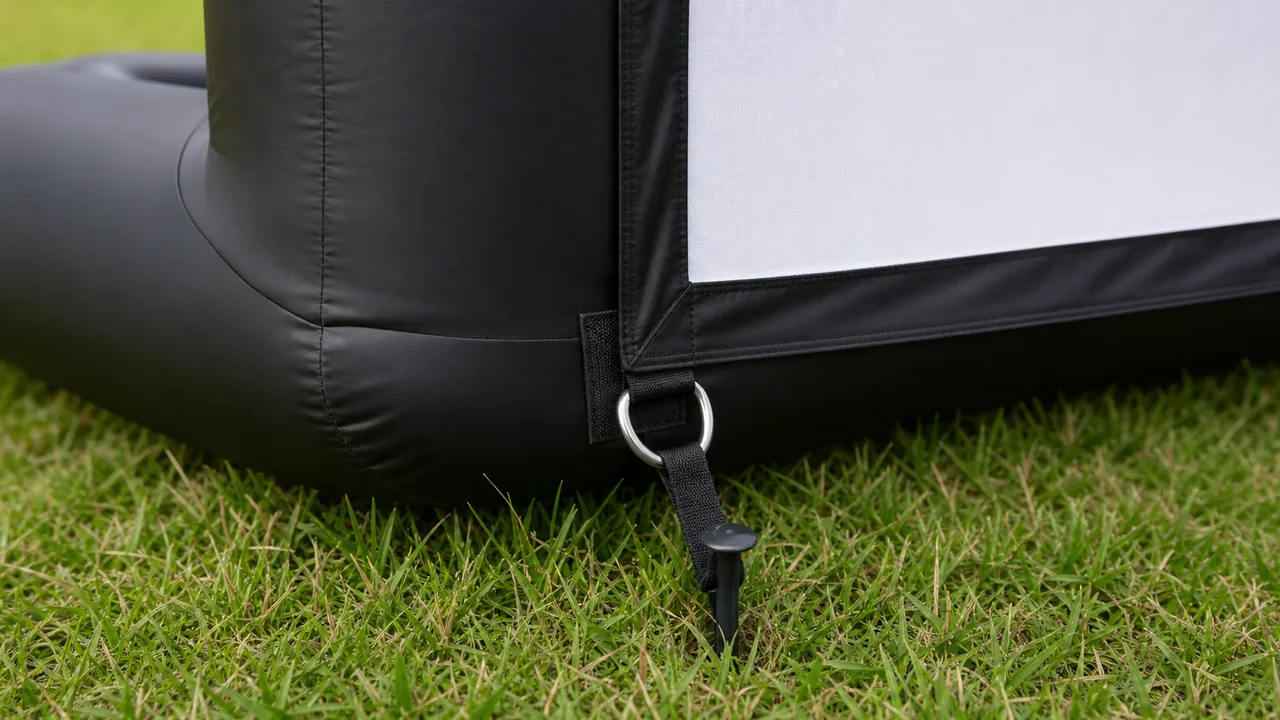
An outdoor movie screen is a large sail, so wind loading is the real engineering problem. Commercial frames use double- or triple-stitched seams, reinforced stress points and heavy 0.55mm PVC on the air beams. The base should carry multiple D-ring anchor points feeding stakes, sandbags or water barrels. As a rule, plan ballast for the worst gust of the evening, not the average — a 30 ft screen catches serious force. We break the math down in our guide to anchor systems for inflatables, and it is worth reading before your first large booking. Confirm the rated wind speed with the factory and set a clear tear-down threshold for your crews.
Turnaround time is margin. A well-built inflatable cinema screen inflates in three to five minutes from a single blower, and a two-person crew can stake, tension and be projection-ready inside twenty minutes. That speed lets one team run multiple screenings a night in peak season. Check that the blower is a standard, replaceable commercial unit, that seams are patch-repairable in the field, and that the storage bag actually fits the packed screen — small details that decide how many bookings a fleet can service.
The screen is the headline, but the show needs a projector and a sound system too. Most commercial screens ship as the inflatable and surface only; the projector, media source and PA are specified separately to match your venue lumens and crowd size. Buyers building a broader event fleet often pair screens with our advertising & event inflatables range so one supplier and one container cover the whole activation. If you are still scoping the model, our overview of starting an inflatable rental business maps how screens fit alongside the rest of a rental catalog.
Packed down, inflatable movie screens ship efficiently — they fold into compact, stackable bags with no rigid frame to eat volume. A mid-size order consolidates neatly into a 40ft HQ container, and choosing the right box saves real freight cost; see our breakdown of 20ft vs 40ft HQ container loading. As a direct factory we keep MOQ low for mixed startup orders and scale to full-container runs for established fleets, quoting FOB or CIF to your port. Production lead time typically runs 15–25 days depending on size and order volume. OEM is standard: custom sizes, printed borders, branded valances and your logo on the screen surround all come off the same line, letting rental brands and event agencies put their identity on every screening.