
Sizing is the hardest decision to reverse in a brincolín purchase. Colour, branding and even blower specification can be changed on the next order; a unit that is too large for your vehicle, too small for your venue's throughput, or too tall for your storage will keep costing you for the whole of its working life. This guide covers how to read a spec sheet properly, what the standard commercial sizes actually deliver, and how to work out the footprint your site really needs — before you commit.
For the occupancy mathematics itself — how maximum user numbers are derived from bouncing-bed area — our guide to weight capacity and user limits covers the calculation in full. What follows is the specification and footprint side of the same decision.
Most spec sheets quote dimensions and price and stop there. Six numbers actually determine whether a unit will hold up in commercial use, and they are the ones worth insisting on before you compare quotations:
Fabric grade and thickness. Commercial units are built from coated PVC tarpaulin, usually quoted as denier plus thickness — 1000D at 0.55 mm is the common commercial baseline, with heavier grades for high-traffic or wet/dry combo units. A sheet that quotes only "PVC" without a grade is not a specification. Our PVC tarpaulin grades guide explains what the numbers mean in practice.
Seam construction. Double-stitched-and-welded seams on load-bearing panels; single stitching on a bouncing bed is a durability problem waiting to happen.
Blower output in CFM. Undersized blowers are the most common cause of a soft bouncing bed, and a soft bed is both a safety issue and a throughput issue. The number to check is CFM against the unit's inflated volume, not the blower's physical size.
Anchor point count and type. The number of attachment points, and whether they are rated for ground stakes, ballast or both, determines where you can actually deploy the unit.
Maximum user height and weight per user. These are hard limits, not guidance.
Packed dimensions and weight. The number your vehicle and your storage will care about most, and the one most often missing from a quotation.
Commercial brincolines cluster around a small number of footprints, and each maps to a recognisable operating pattern:
3×3 m (roughly 10×10 ft). The entry commercial size. Suits birthday-party and small-event work, fits a van, and can be set up by one person. Throughput is limited, so it works as a fleet filler rather than a headline unit.
4×4 m (roughly 13×13 ft). The workhorse. Large enough for a meaningful concurrency, still manageable for a two-person crew and a van or small trailer. This is the size most rental fleets are built around, and the one we see ordered most often for Latin American operators running mixed party and school-event calendars.
5×5 m and above (16×16 ft plus). School fetes, municipal events, festivals. Needs a trailer or truck, a two-person crew, and a site with real clearance. At this size the unit stops being something you drop off and becomes something you plan around.
Shape matters as much as footprint. A castle-style unit with towers and a slide occupies the same ground area as a plain bouncer but presents far more surface area for branding and photographs better at events — which is why the inflatable castles range and the plainer commercial bouncers are usually bought as a mix rather than as alternatives.
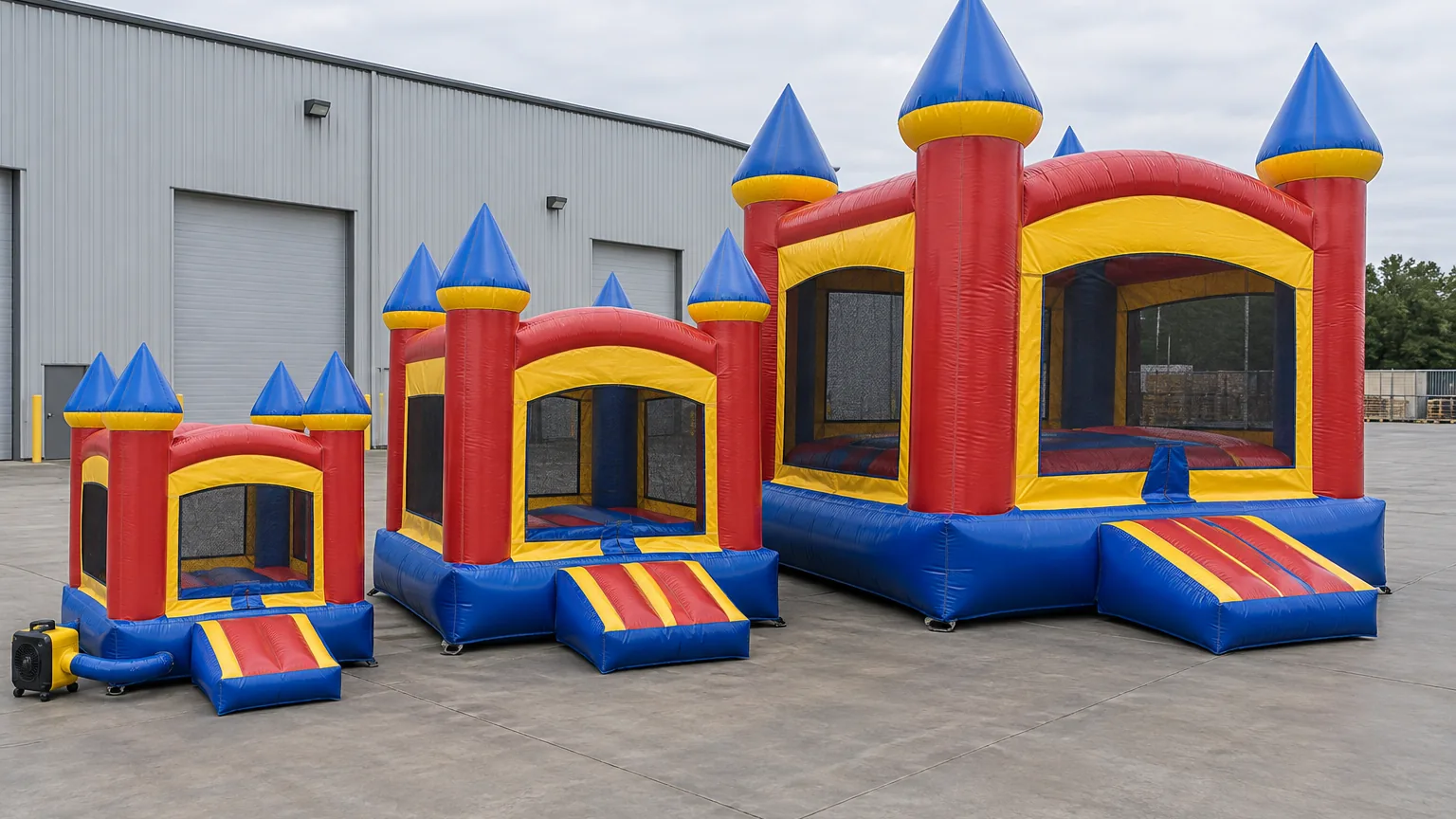
The unit's own dimensions are not the space you need. Allow clear exit and fall zones on every open side, plus room for the blower tube to run without becoming a trip hazard, and check overhead clearance if the site has trees, awnings or cabling. In practice a 4×4 m unit commonly needs something closer to 6×6 m of usable ground once clearance and access are counted.
Ground surface changes the anchoring specification rather than the size. Grass takes ground stakes. Hard standing — plazas, car parks, indoor halls, which is a large share of Latin American urban event venues — rules out stakes entirely and pushes you to water ballast or weighted base plates. That is dead weight you have to transport and set up, and it changes the crew size for the same unit. Decide the anchoring method before you finalise the dimensions, not after.
A brincolín that is right for your events and wrong for your van is not a usable asset. Work backwards from transport: a 3×3 m unit typically goes as a one-person job in a van; a 4×4 m usually needs two people and either a large van or a small trailer once the blower, ballast and repair kit are loaded; 5×5 m and above generally means a trailer or truck. Ask for packed dimensions and packed weight per unit in writing, and add the blower, ballast and accessories — the accessories are frequently a larger volume than buyers expect.
Storage is the same calculation in reverse. Off-season storage needs the unit clean, dry and out of UV, and a folded commercial unit that does not fit your racking will end up stored badly, which is how most avoidable seam and coating damage happens.
Run this checklist against any quotation, whatever the size: fabric grade and thickness stated numerically; seam construction specified; blower CFM quoted against inflated volume; anchor points counted and rated for the surfaces you actually use; maximum user height and per-user weight given; packed dimensions and weight included; and repair kit plus spare blower priced in the same order. If a supplier cannot answer these six, that is the finding — regardless of how attractive the price looks.
Buying for a fleet rather than a single unit changes the emphasis again: mixing sizes across the fleet gives you more deployment flexibility than buying the same unit repeatedly, and it is cheaper than it sounds because the smaller units carry a lower freight cost per event served. If you are building out a rental offering around bounce equipment, our guide to starting a commercial inflatable rental business covers fleet composition alongside the sizing question.
Working out what to buy for a specific venue or event calendar? Send us the site, the expected throughput and how you will transport it, and we will come back with the sizes that fit rather than the sizes we happen to have.
What is the most common size for a commercial brincolín?
4×4 m is the most common commercial size, because it delivers useful throughput while still being a two-person, van-or-small-trailer job. 3×3 m units suit party work and fleet filling; 5×5 m and larger are for festivals and municipal events where a trailer and a bigger crew are already part of the plan.
How much space do I need beyond the unit's own dimensions?
Allow clear exit and fall zones on every open side, room for the blower tube to run clear of walkways, and overhead clearance for trees, awnings or cabling. A 4×4 m unit commonly needs around 6×6 m of usable ground once clearance and access are counted. On hard standing, add the footprint of the ballast or base plates you will be using.
Can the same brincolín be used indoors and outdoors?
Physically yes, but the anchoring specification differs and that is what usually decides it. Outdoor grass sites take ground stakes; indoor halls and hard-standing plazas require ballast or weighted plates instead. Check ceiling height against the unit's inflated height, and confirm the blower can run indoors without becoming a noise or cable-routing problem for the venue.