
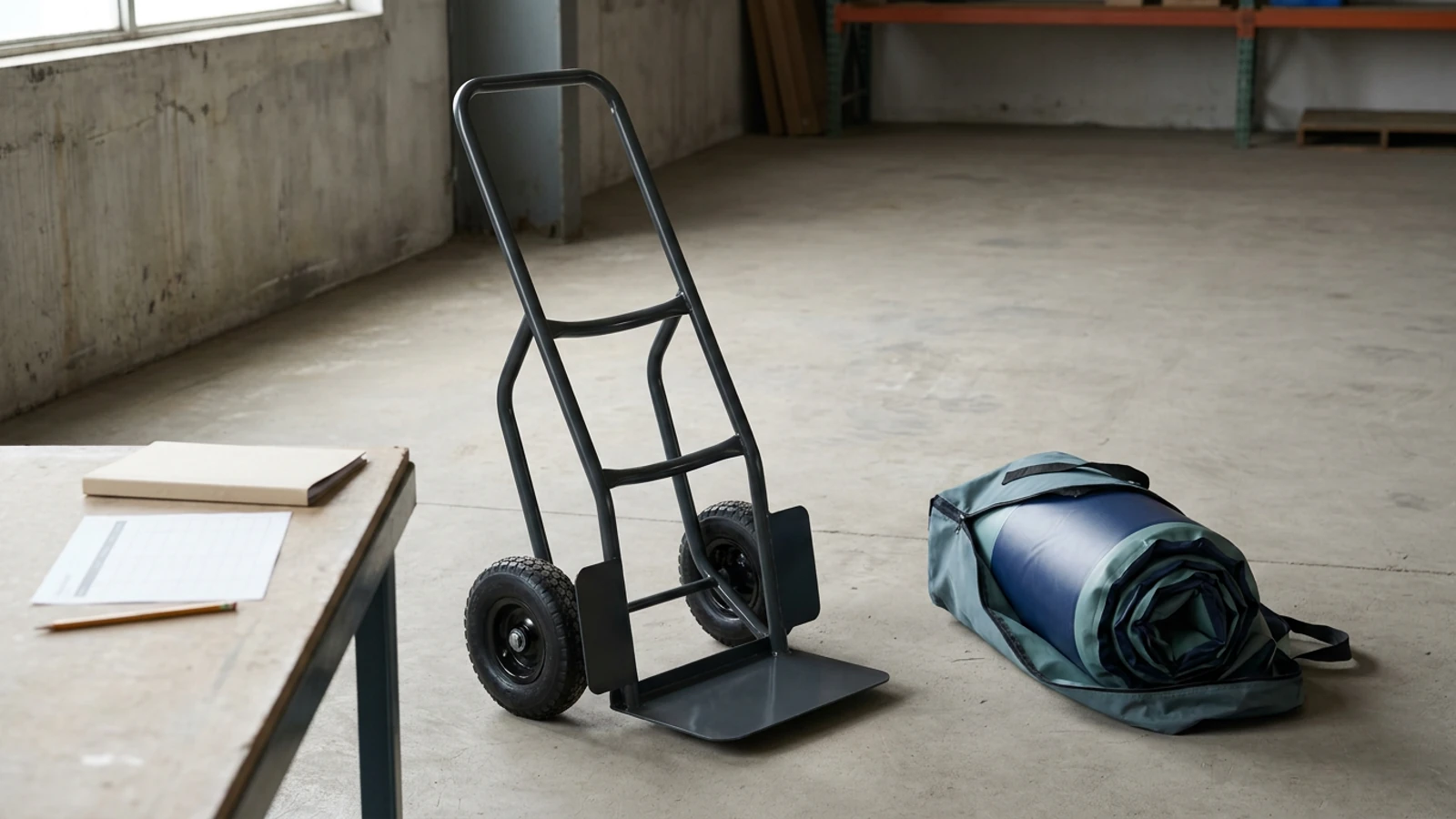
A bounce house dolly needs to fit the equipment you actually move, the conditions in which it will be used and the vehicle that carries the dolly itself. A large capacity number answers only part of that purchasing decision. It does not identify the supported load shape, permitted configuration or working conditions.
For rental operators and inflatable importers, a useful comparison starts with packed-equipment information and ends with a confirmed model-specific quotation. The task here is selecting handling equipment, before planning an individual delivery or operating the cart.
Request the packing information for the actual inflatable model and revision: package identifiers, dimensions, weights and applicable handling instructions. An inflated footprint or a photograph of a rolled unit cannot establish the load the dolly will carry. The commercial inflatable specification guide explains the equipment information to obtain before committing to an order.
Keep individual packages separate in the comparison. A two-bag attraction does not automatically become one permissible dolly load simply because the combined weight appears below a headline rating. Identify the proposed supported package and any accompanying items, then ask the cart supplier to confirm that arrangement.
Record whether the information is measured, supplied by the manufacturer or still an estimate. If the packed configuration is not final, leave the fit decision open. Buying against an assumed roll diameter can leave you with a cart that has adequate nominal capacity but an unsuitable support area.
Compare how each candidate supports and moves the load, rather than treating every inflatable hand truck as the same product. A convertible frame may have different requirements in different positions. Identify the configuration being quoted and the attachments included.
| Configuration | Purchasing questions | Keep separate |
|---|---|---|
| Manual hand truck | What load shape fits its support, and what are its dimensions and own weight? | A load rating does not establish the handling effort or crew requirement. |
| Wagon or convertible arrangement | Which configuration and conversion components are approved for the proposed load? | Do not carry a rating from one arrangement into another. |
| Powered dolly | What drive, braking, battery and charger configuration accompanies the quoted model? | Powered travel does not establish lifting capability. |
| Winch-equipped option | Which attachment, intended task and restrictions are documented? | A winch rating is not the cart rating or permission for an unspecified lifting task. |
A bounce house dolly with a winch may still require manual movement, while a motorized model may be sold without a winch. Ask for an itemized configuration instead of interpreting “electric” or “heavy duty” as a complete specification.
Attach every quoted capacity to a model, configuration and source document. Ask which surface and load conditions it covers and whether an attachment changes the permitted arrangement. Individual tire capacities cannot simply be added to create a new whole-cart rating.
These two manufacturer-document examples illustrate how to read the evidence. They are not a performance ranking or a statement that either product suits your equipment.
| Identified source | What the document states | What still needs confirming |
|---|---|---|
| Jolly Dolly Power PRO product page, checked October 29, 2026 | The page lists a 1,000-pound capacity and an optional winch. | Obtain the applicable instructions and configuration-specific conditions for your proposed load; the headline is not approval for a particular slope or handling task. |
| Overland manual 97012-5, revised March 2023, for Powered Multi-Mover XT, Transformer and Appliance Cart | The FAQ states a maximum load of 750 lb for level ground. | Confirm whether this manual applies to the exact product offered. Do not transfer its level-ground figure to another model or use it as a slope allowance. |
Model names matter even within one manufacturer’s website. The separate Jolly Dolly specifications page includes a section headed Power Plus Motorized. Do not combine that section’s battery or drive details with the Power PRO quotation. Request a single confirmed specification for the model and revision you are buying, and retain the supplier’s explanation of any differences.
Compare the support surface and loaded envelope, not just the bare frame width. Ask how the proposed roll is supported in the approved arrangement and obtain the resulting overall dimensions. Keep attachments and the space needed for handling in that review.
Use confirmed venue constraints as purchasing inputs. The venue access checklist covers establishing the route and its restrictions; this comparison does not replace that survey. A cart fitting through one opening does not establish suitability for the complete job.
Also account for the dolly as cargo. Obtain its own weight and dimensions in the transport configuration, including the quoted attachments. Check the effect on available vehicle space and payload through your normal vehicle assessment. The separate road transport and load-protection guide covers the vehicle journey; a cart brake is not evidence of an approved road-restraint arrangement.
For an electric dolly for inflatables, distinguish the drive battery specification from the charger’s supply requirements. Request the actual battery and charger references, charger input rating, connector information and instructions for the destination. A battery voltage does not tell you which mains supply the charger accepts.
Ask for the basis of any runtime estimate: load, surface, duty pattern and test conditions. A statement about a working day is not a guaranteed number of deliveries. The Overland manual above expressly relates battery runtime to carried weight and surface conditions; that observation does not establish another manufacturer’s runtime.
Confirm who provides support in your country, which parts and documents are available, and the warranty and service process for the offered configuration. Obtain any required shipping information for the actual battery system from the relevant supplier and carrier. This is a procurement question, not a battery-shipping classification or customs determination.
Send each candidate supplier the same load information and confirmed constraints. Ask the supplier to demonstrate suitability under its instructions, with the proposed configuration and a representative load. Record what the demonstration establishes and what remains unresolved; watching a promotional video does not verify your own arrangement.
| Comparison field | Record for each candidate | Evidence to retain |
|---|---|---|
| Proposed load | Package reference, dimensions, weight and associated items | Actual packing information and its status |
| Cart identity | Model, revision, configuration and included attachments | Itemized quotation and applicable manual |
| Support and fit | Support dimensions and loaded envelope | Supplier confirmation for the proposed arrangement |
| Capacity | Whole-cart rating with stated conditions | Matching specification; unresolved conditions identified |
| Transport burden | Cart weight and packed or transport dimensions | Configuration-specific data |
| Powered system | Battery, charger input and runtime basis, where applicable | Matching references and instructions |
| Ownership costs | Quoted equipment, accessories, delivery and service terms | Written scope and exclusions |
| Decision status | Confirmed points, open questions and review owner | Dated responses and demonstration record |
For example, in a fictional comparison, Candidate A supplies a capacity figure but no confirmation of the proposed roll’s support. Candidate B supplies dimensions but has not identified its charger input. Both remain pending for different reasons; the worksheet does not select a winner from incomplete information.
Keep general inflatable accessories and spare-parts procurement separate from the cart quotation. Once the handling arrangement is confirmed, use the delivery scheduling workflow for the actual jobs rather than treating a cart purchase as proof of route capacity.
When enquiring about an inflatable order, ask the inflatable supplier for confirmed packed dimensions, package weights and handling information to share with your chosen cart supplier. This guide does not represent that Inflatablecn manufactures, stocks or sells the dollies discussed. Product examples identify source documents; they are not endorsements or offers of supply.