
Getting a commercial inflatable across the ocean in a container is a solved problem. The harder, more frequent challenge is the weekly road haul — loading a trailer or van, driving to a venue, and getting the same unit back undamaged for next weekend. That repeated handling is where most rental fleets quietly lose lifespan.
This guide covers transporting inflatables for domestic operations: how to fold and stack, distribute weight, protect against abrasion and moisture, separate blowers and anchors, and stay legal on the road.
If you have ever received a 40ft HQ container of units, you know export packing is built around one long, sealed, climate-stable journey: vacuum-style compression, pallet stacking, and dense cube utilization to maximize MOQ per container. The unit gets handled twice — once loaded at the factory, once unloaded at your warehouse. For the mechanics of that side, see our container loading guide: 20ft vs 40ft HQ and the deeper container packing and freight protection breakdown.
Domestic transport is the opposite problem. Short trips, but many of them. A unit might be loaded and unloaded 100+ times a season, often by tired crews in the dark, in rain, onto trailer decks with grit on them. The enemy is not crush damage from a 30-day voyage — it is cumulative abrasion, repeated tight folding along the same crease, moisture trapped between trips, and shifting loads. Your packing system has to be fast, repeatable, and protective, not maximally dense.
| Factor | Export ocean freight | Domestic road haul |
|---|---|---|
| Frequency | Once per shipment | Weekly / per event |
| Main risk | Crush, long-term moisture | Abrasion, fold fatigue, load shift |
| Priority | Cube density / MOQ | Speed + protection + repeatability |
| Handling | Forklift, palletized | Manual, 2-person lift |
A rolled commercial bouncer or combo can run 80–180 kg; a large slide or obstacle course splits into multiple bags, each 40–90 kg. Distribute that mass correctly or you will fight the trailer the whole drive.
In a cargo van, the same logic applies but you lose lash points — use E-track or a cargo bar so the load cannot pile forward into the cab under hard braking.
How you fold determines how long the PVC welds last. Two rules: vary the fold line so you do not crease the same seam every week, and never roll a wet unit for storage transit if you can avoid it.
This connects directly to off-season care — the same discipline that protects on the road protects in the warehouse. See our inflatable storage and off-season maintenance SOP for the longer-term routine.
The single most common avoidable damage is hard accessories riding loose against soft PVC. Keep them physically separated from the fabric.
Standardize the kit so every job leaves with the same boxes. Browse the Accessories category for blowers, anchors, stakes, and storage bags that match commercial units.
For a route with several drops, load in reverse delivery order — last in, first out. The first venue's complete kit (unit, blower, anchors, signage) goes on last, nearest the door. This sounds obvious until a crew has to unbury a 150 kg roll at stop one because someone loaded by size instead of by route.
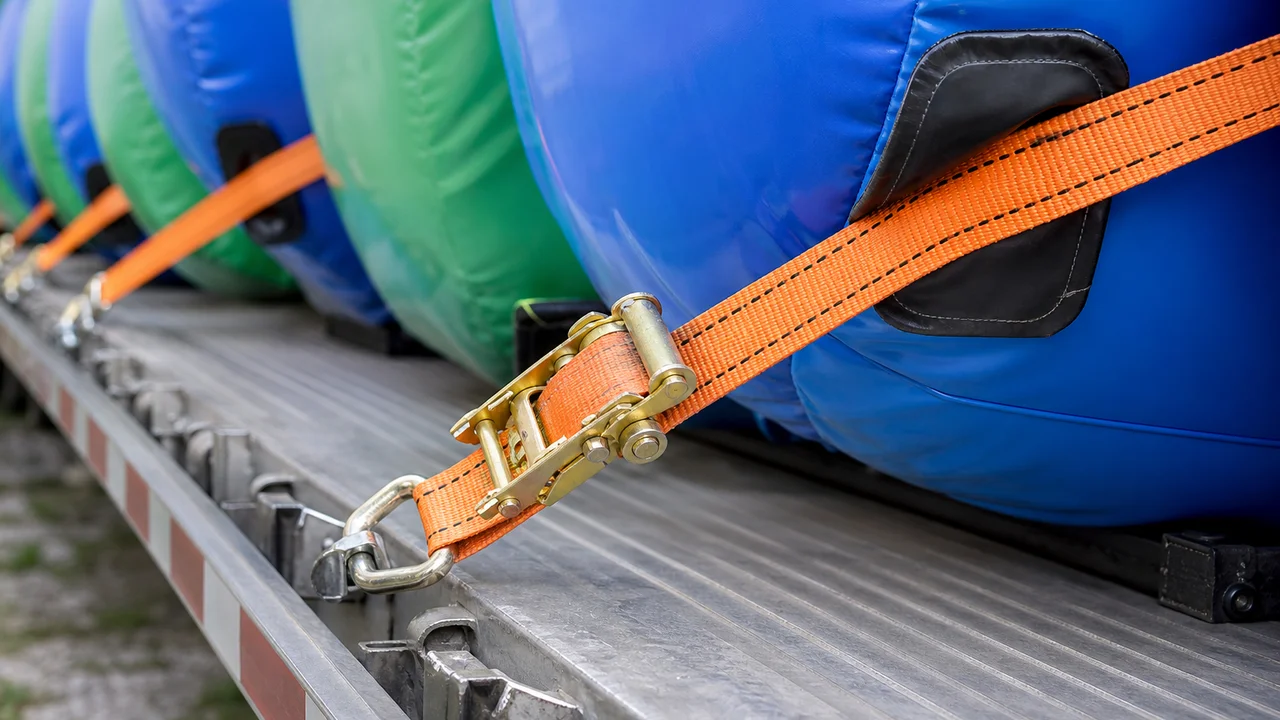
Once loaded, the cargo has to stay put and stay legal. Soft cargo lulls people into under-securing — don't.
Good transport packing pays off at the venue. If units arrive swept, dry, rolled in delivery order with their kit bundled, the setup crew can move straight to positioning and anchoring instead of untangling cords and hunting for stakes. That handoff is where road discipline turns into faster, safer installs — covered in our inflatable setup crew installation SOP.
Treat loading and unloading as a defined procedure, not an afterthought. The fleets that get the most seasons out of a unit are not the ones that drive carefully — they are the ones that fold, separate, and secure the same way every single trip.