
France is one of the few European markets where a commercial inflatable water park can be run on a lake, in a purpose-built basin, or beside an existing pool—and the three routes carry different obligations. This guide is written for French operators, campsite groups and event companies planning a purchase from China: what to buy for which site, which administrative questions to close before the order, how water treatment ties into the authorisation, and how to compare two quotes on the same basis.
It is not a legal summary. Requirements are set by the site and by the authority that authorises it; the aim here is to make sure you ask the right questions before any deposit is paid.
Three formats cover most French installations, and the choice follows the water you already have rather than the catalogue:
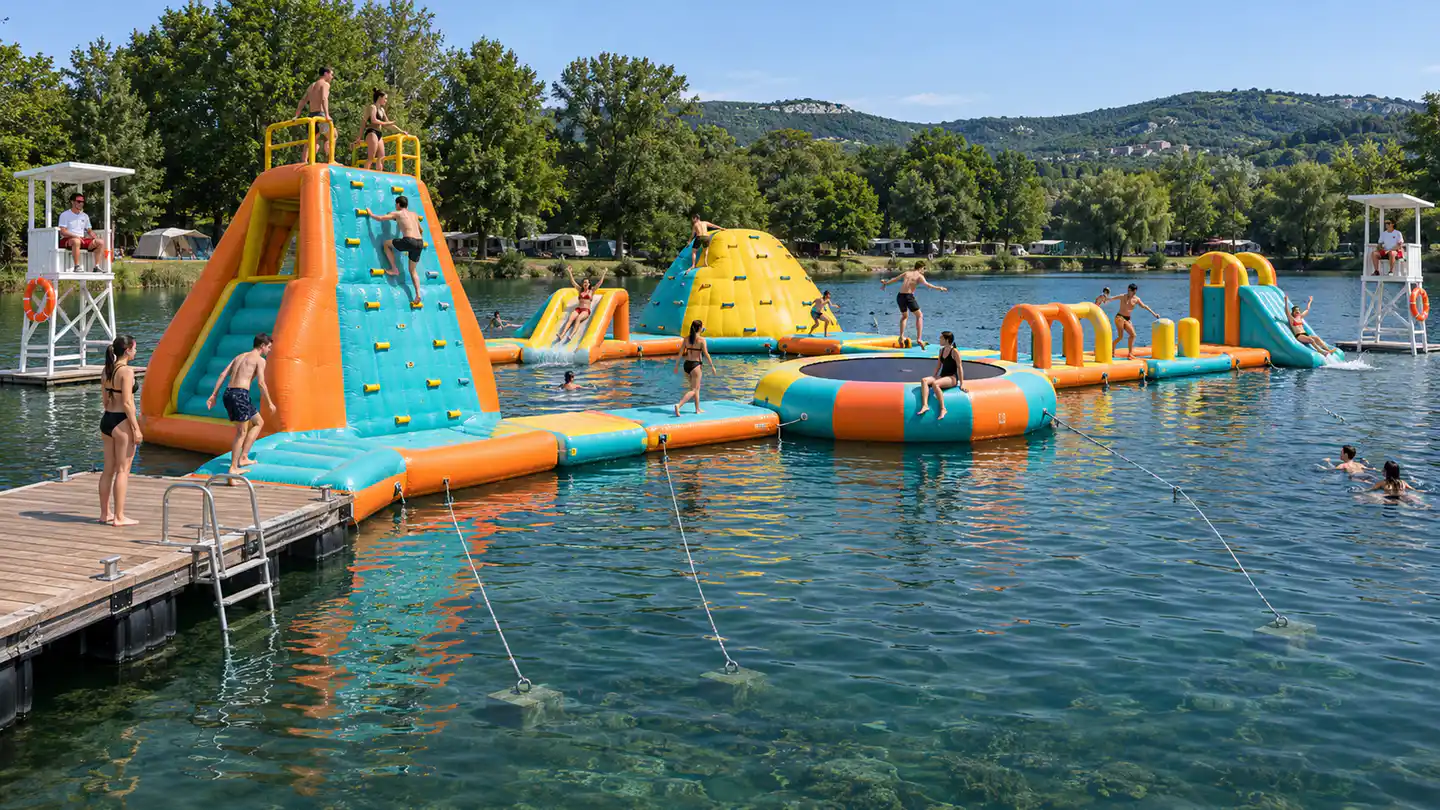
The operational consequences differ sharply: an open-water park carries mooring and rescue-plan obligations, a basin installation carries water-treatment obligations, and a poolside module carries neither in the same form. Decide the category first, then compare products. For a complete layout rather than individual units, start from the complete inflatable water parks range.
Two conversations decide whether a project is viable, and both should happen before a drawing is approved.
Site authorisation. Whether the site can host a public bathing or paid attraction depends on its classification and on the local authority that authorises it—the commune, the intercommunal structure, or the prefecture depending on the site. Ask them what file they require, and ask in writing, because the answer determines whether the park needs a fixed installation plan or a removable seasonal one.
Water quality and treatment. For a basin or pool installation, water quality is monitored and the responsible regional health agency (ARS) is the reference for the sampling regime. The treatment system has to be sized for the guest load the park will create, not for the pool as it stood before. A park designed for 120 bathers in a basin sized for 40 is a compliance problem, not a marketing decision.
Do not treat either conversation as a formality. Both can change the design: the number of modules, the entry and exit points, and whether the units have to be removed at the end of the season.
Adding modules adds bather load, and bather load drives filtration turnover, disinfection demand and the sampling frequency the operator must sustain. Before ordering a second phase, ask the treatment supplier for the current turnover margin and the load it was designed for. If that margin is already thin, the second phase needs treatment capacity in the same budget, and that cost belongs in the business case rather than in the contingency.
The practical detail that catches operators out is the water volume inside the units themselves—inflatable attractions hold water in pockets that exchange slowly with the rest of the basin. Plan the circulation and the sampling points with the treatment supplier, and read the water management guide for inflatable pools and parks before fixing the layout.
Two parks with the same number of modules can serve very different guest volumes, because throughput is set by the entry points and the queue paths, not by the unit count. Send the factory measurable inputs and the layout can be checked against the water you actually have.
| Site input | What it determines in the design |
|---|---|
| Water area and shape, with dimensions on a plan view | How many modules fit and in what arrangement |
| Depth readings across the area, not a single spot figure | Which modules can be placed where, and where they cannot go |
| Guest entry and exit points | Queue paths, supervision positions and the phase order |
| Target guest volume per session | Number of entry ladders and the capacity of each unit |
| Season length and storage on site | Whether units stay in the water or are removed daily or weekly |
| Power position and supply | Blower placement and cable routing for constant-air units |
If the park will be built in stages, the modular water park modules range sets out how individual units are specified, and the guide to module compatibility when expanding a park covers what has to match between phases.
French importers usually consolidate through Le Havre, Marseille-Fos or Dunkirk, and the realistic planning constraint is not production but the sea leg plus clearance. Build the schedule backwards from the opening date: production slot, container booking, ocean transit, customs clearance, inland delivery and installation. A park that has to be in the water for the first week of July cannot be ordered in June.
| Stage | What you control | What you should confirm in writing |
|---|---|---|
| Specification freeze | Layout drawing, module list, anchor plan | Signed drawing and bill of materials per unit |
| Production | Order date and quantity | Production slot and inspection points |
| Container loading | Mixed models and accessories | Packed volume per unit and loading plan |
| Ocean freight | Port of arrival and Incoterm | Sailing schedule and the party responsible for each leg |
| Clearance and delivery | Customs broker and inland haulage | Documents list, HS classification and the delivery address constraints |
Certification paperwork should travel with the goods, not arrive after them: request the conformity documents for the exact models ordered, and check that the model reference on each document matches the unit in the container. Buyers comparing an inflatable installation with a fixed pool should also read the ten-year cost comparison for inflatable and fiberglass pools, which sets the capital and relocation maths side by side.
Operating cost, not purchase price, decides whether a French installation works. The line items are consistent across sites even when the amounts are not:
Model the shoulder weeks explicitly. A park that only breaks even in August but carries supervision and treatment costs through a longer calendar is a different business from one that opens for six concentrated weeks, and the design—fixed or removable, basin or open water—should follow that answer.
Get the answer before the layout is finalised.
If the margin is thin, price the treatment upgrade into phase one.
This changes anchoring, cleaning routine and insurance conditions.
Match the reference on each document to the units on the order.
Pack volumes, labour and storage space are recurring seasonal costs, not one-off details.
Send the site plan, depth readings and opening dates with your enquiry, and the layout can be checked against the water you actually have rather than against a catalogue footprint.