Settle the Spanish safety rules text when you confirm the order, not after the castles are sewn. Take every number on the panel, such as the user limit, age or height band and weather limits, from the documents for that exact model. Then approve a printed-size artwork proof before production. If the units will work in more than one country, or the wording may change, order a separate removable rules banner instead of printing everything on the castle body.
Adding a rules panel after production means a reprint, a new panel sewn in and a later ready date. Getting it right at the order stage costs nothing extra in time.
There are two common options, and many operators use both.
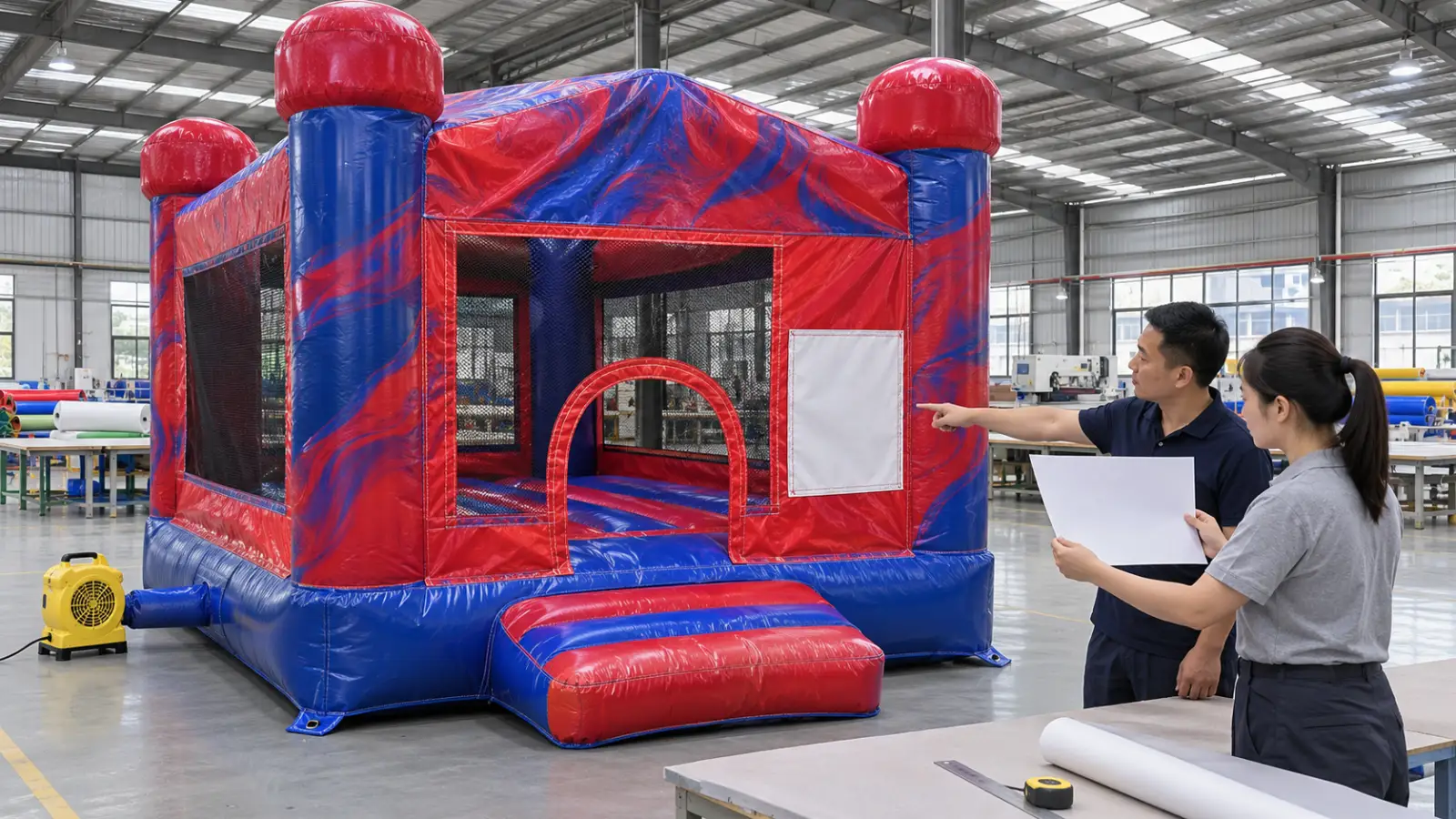
Printed or sewn on the castle. The rules panel is part of the unit, usually on the front wall beside the entrance. It cannot be left behind at a party and it is always in view. It is also hard to change, so it suits wording that will stay valid for the life of the unit.
A separate rules banner. A printed banner tied to the unit or set on a stand at the entrance. It can be swapped for another country, updated when your rules change, or replaced when it wears. It needs to be packed and set up on every job, so add it to your crew's setup checklist.
A practical split is permanent safety content on the castle and market-specific content, such as your company contact, on the banner.
You provide the final Spanish wording. The factory prints what you approve. It does not decide what your local rules require, and it should not be asked to translate legal requirements on your behalf.
Before you send the text, check what applies where you operate. That covers the standard the unit is built to and any local or municipal rules for amusement equipment, which vary across Spanish-speaking markets. If you are unsure, ask your insurer or local inspector what they expect to see posted at the entrance.
Keep the text short enough to read at a glance: who may use the castle, how many at a time, what to remove before entering, behavior that is not allowed, and when the unit must be cleared, such as in rain, strong wind or a loss of blower power.
Do not estimate the user limit or age band. These figures belong to the specific model and are set by its play area and design. Our guide to how maximum occupancy is calculated explains why two castles with the same footprint can carry different limits.
Ask the supplier to confirm the user limit and any height or age restriction for each model in writing, and check that the panel uses the same figures. If you are ordering several models from the inflatable castles or inflatable bouncers range, each one needs its own panel. A shared panel with one set of numbers can be wrong for some of them.
Treat the rules panel like any other printed artwork. Our artwork approval workflow for custom inflatables covers file formats and proof rounds. For a safety panel, also check:
Spelling and accents. Missing tildes and accents are common when text passes through design software. Read the proof as a native Spanish speaker would, word by word.
Numbers. Compare every figure on the proof with the model's written specification.
Size and placement. Ask for the panel dimensions and its position on the drawing, and confirm the text can be read from where a parent stands at the entrance.
Contrast. Light text on a busy theme print is hard to read. A plain background behind the rules is safer.
Approve the proof in writing and keep it with the order. Later changes to the approved proof can move the ready date, so ask for the new date before you send a correction.
In this illustrative example, a distributor orders four castles from two models for rental operators in Mexico and Chile. The first draft is one rules panel for all four units, with one user limit and wording written for the Mexican market.
The distributor changes three things. Each model gets its own panel with the user limit from its own specification. The printed panels keep only the safety content both markets share, in neutral Spanish. Operator contact details and any country-specific requirements go on two removable banners, one for each country.
The proofs go through one correction round for a missing accent and a wrong figure on one panel. The distributor approves them before production starts, and the ready date does not change.
When the order lands, inflate each unit and compare its panel with the approved proof. Check that the banner for the right country is in the shipment. If you reorder the same model later with different wording, treat it as a change to approved artwork. Our guide on when repeat orders need a new sample explains how to handle that.
If you are planning castles for Spanish-speaking markets, send the model codes, your final rules text and the countries of use when you request a product quote.