
Buyers tend to think the hard part of a giant inflatable is making it big. It isn't. Scaling a 4 m mascot up to a 12 m landmark replica is straightforward on the cutting table. The real problems start the moment that volume meets wind, a shipping container, and an install crew on a tight schedule. A large-format inflatable that looks spectacular in a render becomes a safety and logistics headache if the structure type, anchoring plan, and container math were never engineered for that size.
This guide is about the scale engineering — the decisions that separate a giant build that goes up clean and stays up from one that tears, drifts, or sits in customs because it was packed wrong. If you need the broader category overview first, see our outdoor advertising inflatables guide; here we go straight at what changes when the dimensions get serious.
In trade terms, "giant" usually means anything above roughly 6 m in any single dimension, or any unit whose deflated weight crosses the threshold where two people can no longer handle it safely. At that point the build leaves the standard catalog and enters engineered territory. Common giant commercial inflatables buyers source include:
You can see the full advertising inflatables range for the standard formats these scale up from. The point of the list is this: every one of these behaves differently once it is genuinely large, and the structure type is the first fork in the road.
There are two ways to keep a giant inflatable rigid, and at scale the choice is rarely optional.
Sealed (air-tight) structures are inflated once and closed off. They hold their air without a running blower, which makes them clean and quiet — ideal for smaller figures and short-duration indoor displays. But seams on a sealed unit carry constant internal pressure, and that pressure load grows with volume. Above a certain size, holding a sealed giant rigid for days outdoors is impractical: any minor leak deflates the whole structure, and the seam stress at large dimensions makes failure more likely.
Constant-air (open) structures run a continuous blower that replaces air as it escapes. This is the standard for nearly all large-format outdoor builds. The blower lets the unit tolerate small leaks, flex in wind without bursting, and stay up for weeks. The trade-off is a power requirement at every install site and a blower that must run 24/7 while the unit is deployed. For most custom giant inflatable projects above 8 m, constant-air isn't a preference — it's the only structure that survives real-world deployment.
Get this decision wrong and everything downstream breaks: a sealed unit specced for an outdoor week-long activation will sag by day two; a constant-air unit ordered for an indoor lobby with no accessible power becomes useless.
This is where giant inflatables hurt people who underestimate them. Wind load is a function of surface area, and surface area grows with the square of the dimensions. Double the height of a figure and you roughly quadruple the area the wind pushes against. A breeze that a 4 m mascot shrugs off can turn a 12 m replica into a sail trying to walk across a parking lot.
Two numbers matter on every giant deployment:
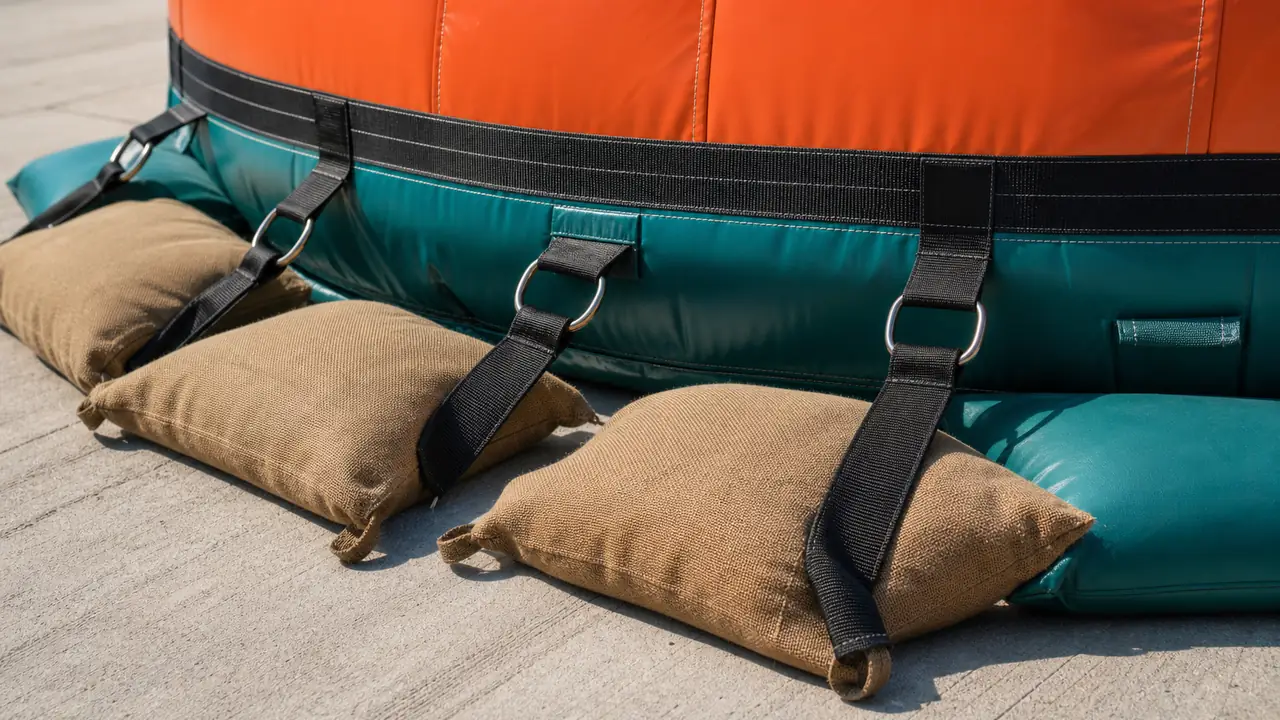
Anchoring options scale up accordingly: heavy sandbags, water ballast tanks, and ground stakes for soft ground, often used in combination on a single unit. Each method has trade-offs in weight, setup time, and surface compatibility — our full breakdown of anchor systems for commercial inflatables covers the load math. The rule for giants: anchor for the gust, not the average, and never rely on the unit's own weight to hold it down.
A giant inflatable is mostly air, but deflated and rolled it is a large, heavy, awkward bale. Buyers routinely underestimate packed volume and end up paying for a half-empty container or, worse, discover their build won't fit the container they booked.
A single 12–15 m figure in heavy PVC can fill a meaningful share of a 40ft HQ on its own once you account for the blower, anchoring kit, repair materials, and crating. PVC coating weight drives this — giant outdoor builds typically use 0.55 mm (about 610 gsm) or heavier material, and that weight adds up fast across hundreds of square meters of fabric. The denser the material, the better the wind and abrasion performance, but the more container space and freight weight you commit to.
Plan the load before you plan the build. If you're shipping multiple units or combining a giant with other stock, the difference between formats matters — see our 20ft vs 40ft HQ container loading capacity guide to run the math on FOB versus CIF freight before you commit to a build size.
Standard inflatables are a two-person job. Giants are not. A large-format figure or replica typically needs a crew of three to six for safe layout, inflation, and anchoring, plus enough clear ground to roll the unit out flat before inflating — you cannot inflate a giant in a tighter footprint than its deflated layout area.
Site checklist for any giant deployment:
Most giant projects are bespoke. A giant inflatable replica of a specific product or a brand-locked figure is custom tooling from artwork up, which means a longer lead time than catalog stock — typically several weeks of design approval, prototyping, and production depending on complexity and finish. Build that runway into your campaign calendar. For figure and character work specifically, our custom inflatable cartoon figures category shows the OEM range we tool from.
The ROI case for going giant is simple and real: visibility scales with size. A 15 m landmark replica is seen from highways, photographed, and shared in a way a banner never is — one well-placed giant can anchor an entire activation and earn impressions long after the event through social sharing. The value isn't in the unit cost; it's in the cost-per-impression across a reusable asset that redeploys for years. Order in volume against a build season and the MOQ economics improve further.
A giant inflatable is an engineering decision before it's a creative one. Lock the structure type to the deployment, anchor for the worst gust your site can throw, confirm the container math before you confirm the size, and staff the install honestly. Get those four right and a large inflatable figure becomes the most photographed thing at your event. Get them wrong and it becomes the most expensive lesson.