
Few attractions pull a crowd like the sight of karts and bumper cars weaving between bright inflatable walls. For a family entertainment center, an event company or a mobile rental operator, an inflatable go kart track turns an empty hall or a flat parking lot into a ticketed racing arena in under an hour. The vehicles themselves are electric or petrol machines, but the part you source as a soft-play product is the arena around them: the crash-absorbing barriers, the base mats and the modular track sections that shape the course. This guide breaks down the category, the materials that matter and the logistics of buying for export.
When buyers say "inflatable race track," they usually mean one of three product types, and most FECs end up owning a mix of all three.
These are the modular sealed-air or continuous-blower walls that outline the racing lane. They act as guard rails, keeping karts on course and absorbing side impacts that would otherwise dent metal barriers or hurt drivers. Barrier sections connect end to end so you can lay out an oval, a figure-eight or a tight technical circuit. Height typically runs 0.6–1.0 m for karting — tall enough to redirect a vehicle, low enough for marshals and spectators to see over.
An electric bumper car inflatable setup is a fully enclosed square or round pen with cushioned perimeter walls and a smooth, seamed base mat that the cars glide on. The inflatable defines a safe collision zone; the cars — powered by floor grids or onboard batteries — stay contained no matter how hard riders slam into the walls. A 10 x 10 m pen comfortably runs 6–8 cars.
The largest builds combine barriers, chicanes and inflatable pit sections into a full inflatable karting arena. Because the pieces are modular, one operator can run a compact 100 m² sprint track indoors this weekend and a 400 m² endurance circuit at an outdoor festival the next.
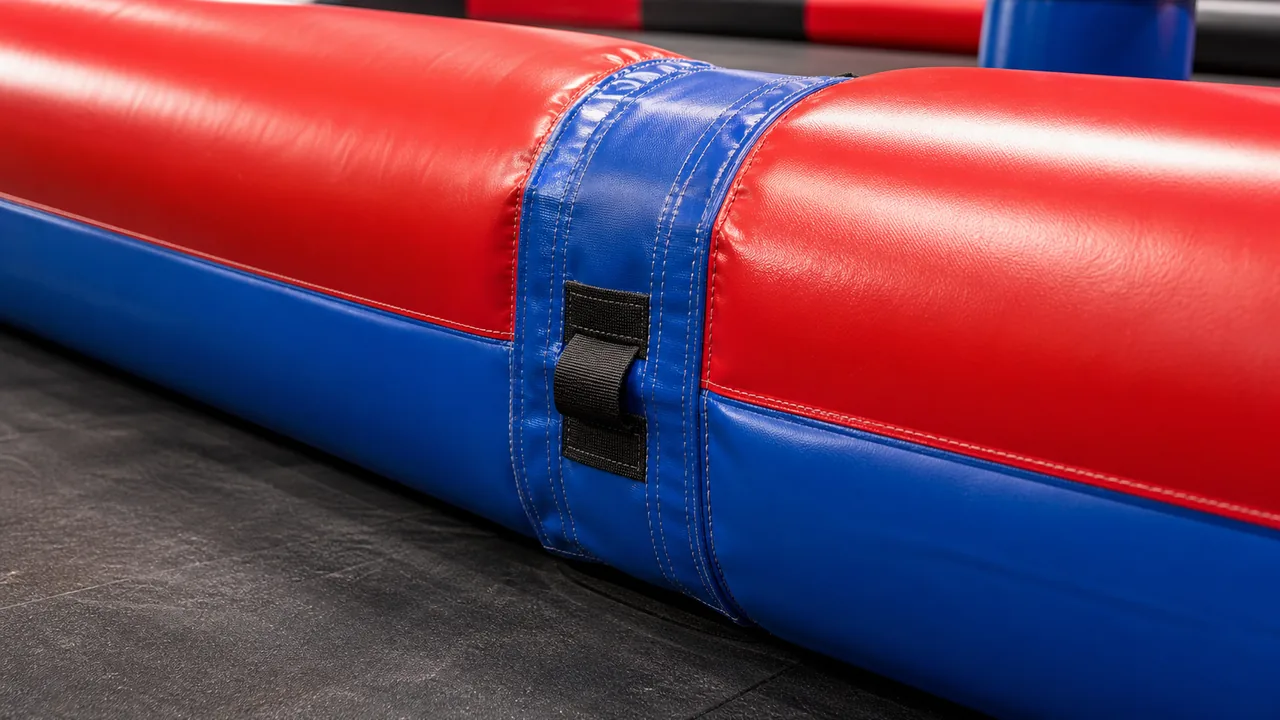
This is where cheap and commercial product part ways. Barriers take repeated vehicle impacts, so the walls should be built from 0.9 mm PVC tarpaulin — the heavy 850–1000 gsm grade that resists abrasion, seam blow-outs and UV fade. Lighter 0.55 mm fabric is fine for a bouncer but will split under kart contact within a season. Base mats need an even tougher wear layer, often double-coated PVC, because drive wheels and caster forks grind against the same spots all day. If you want to compare fabric weights before you commit, our breakdown of PVC tarpaulin grades shows what each thickness is actually good for.
Structurally, you choose between two systems. Continuous-blower barriers stay inflated by a quiet electric fan and shrug off punctures — a small leak just means the fan works a little harder, so they suit high-impact karting. Sealed-air (airtight) sections need no running blower and pack down smaller, which is ideal for bumper car pens and touring rental kits where setup speed matters more than absorbing 200 kg of moving steel. Reinforced stitching, welded seams and D-ring anchor points are non-negotiable on either system.
Plan the arena around throughput, not just the footprint. A single-kart sprint lane needs roughly a 4 m width to let vehicles pass; a two-lane racing circuit wants 6 m or more. As a working rule, budget 25–35 m² per active kart once you account for the racing line and run-off. Bumper car pens are denser — one car per 12–15 m². Modular barriers let you dial the layout to the venue: tighten the chicanes for a small mall atrium, open it up for a stadium concourse. This kind of reconfigurable, high-visibility attraction sits naturally alongside the rest of a commercial inflatable sports range, so operators can rotate stock and keep repeat visitors engaged.
Soft barriers are a safety feature, but they don't replace a safety program. Insist on flame-retardant PVC that meets your market's standard, non-slip base seams, and clearly marked entry/exit gaps that marshals control. Speed governors on the karts, seat belts or lap bars on bumper cars, and a supervised age/height policy do the rest. The same operational discipline covered in our inflatable obstacle course buyer's guide — marshal ratios, load limits, daily inspection — applies directly to racing arenas.
Rental economics live and die on setup time. A two-person crew should stand up a mid-size barrier circuit in 30–45 minutes: unroll, connect sections, inflate, anchor. Sealed-air bumper pens are faster still. Look for color-coded connectors and numbered sections so a new crew doesn't need the manual, and specify a carry bag or wheeled crate per module. Quick strike-down also protects your margin on multi-venue weekends.
Deflated and rolled, these arenas ship efficiently. A complete bumper car pen plus barrier kit compresses into a handful of crates; a full modular karting circuit fills part of a 40ft HQ alongside blowers and spares. Because volume, not weight, drives the freight bill, tight rolling matters — the same container math we walk through in our guide to 20ft vs 40ft HQ container loading applies here. On MOQ, a single arena is enough to start; combine it with other lines to hit a full FOB or CIF container and your per-unit landed cost drops sharply. OEM and OEM-color branding — sponsor logos, corporate colors, custom track shapes — is standard on commercial orders and turns a generic pen into a branded attraction. The ROI case is simple: one durable, reconfigurable arena books racing parties, corporate events and festival gigs for years off a single purchase.
Want more ways to keep a venue busy between race sessions? See our roundup of inflatable interactive & competition games for attractions that pair well with a karting arena.