
You have a calm lake, a sheltered bay, or a deep resort pool — and you want a flagship attraction that pulls hundreds of guests through the gate every day. Buying a single off-the-shelf bouncer won't get you there. What you actually need is a modular inflatable water park: a kit of mix-and-match floating structures sized to your water depth, your guest capacity, and your operating model. This guide walks resort and hotel buyers through how those modules are specified, certified, and shipped — from first site survey to the day the container arrives.
A modular inflatable water park is not a fixed product. It is a set of independently anchored floating units — slides, climbing walls, jumping platforms, trampolines, obstacle bridges, swing arms — that connect via tethers and walkway sections. Each module is engineered to stand alone, but the layout is custom-designed for your specific water area.
The opposite is a fixed-design aqua park: one large, all-in-one inflatable that arrives in a single configuration. Fixed parks ship faster, but they constrain you. If your lake is L-shaped, if half your guests are children, or if you want to swap in new modules every season for repeat visitors, modular wins. Most commercial resorts now choose the airtight modular aqua play family for exactly this flexibility.
A complete water park typically draws from five product families. Knowing what each one does makes layout conversations with a manufacturer far more productive. When weighing which modules deliver the best return, our breakdown of inflatable pool tracks vs solid pool toys is a useful starting point.
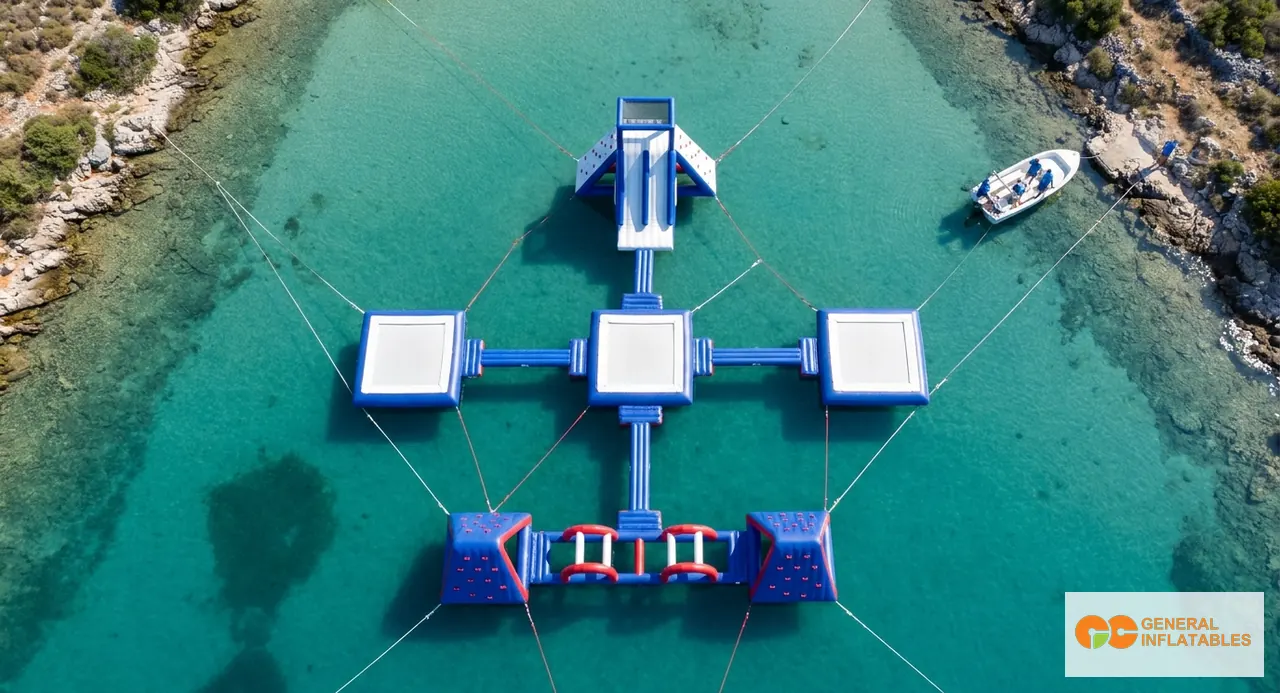
For full open-water destinations, see how the complete inflatable water parks line bundles these into pre-engineered layouts for 50, 100, and 200+ guest capacities.
Two physical constraints govern your module choice before any aesthetics enter the conversation.
Water depth. Slides higher than 3 m require a minimum landing depth of 2.0-2.5 m for safety. Climbing walls and high jumping platforms need similar clearances. If your pool is 1.5 m at the deep end, you are working with low-profile obstacles only — and that is fine for family-oriented venues. Submitting a bathymetric map of your water area in the first email saves weeks of back-and-forth. For the slide stations themselves, see how inflatable slip and slides are engineered for safe water landings.
Guest capacity. A working planning number is one guest per 8-10 m² of active park surface, allowing for queueing and rest. A 200-guest park therefore needs roughly 1,600-2,000 m² of inflatable footprint, plus a perimeter buffer for boat patrol and lifeguard zones. The Water World series documents capacity bands that fit common resort sizes. For a worked example, our guide to aqua park design and layout walks through planning a 200-guest floating aqua park.
Throughput matters more than capacity for revenue planning. A guest typically spends 60-90 minutes per session. If you sell timed entry, daily capacity is your peak number multiplied by the number of sessions you can run.
Wind exposure is the third constraint that buyers often underestimate. Open lake or ocean sites with prevailing winds above 25 km/h need shorter towers, low-profile climbing modules, and a denser anchor pattern. A sheltered cove or enclosed swimming area can carry taller slides safely. A 15-minute conversation about prevailing wind direction during site survey often reshapes the module list more than any other input.
For the structural side of that sizing — static water load, dynamic bather load and anchor point loads — our adult inflatable water park load rating guide covers the calculations.
For commercial parks operating in regulated markets, the certificate stack is non-negotiable. Ask for the actual test reports, not just logos on the brochure.
A factory shipping into multiple regions should be able to provide all four. A factory that can only show one is fine for a single-market venue but limits your future flexibility. A factory shipping EN 14960-tested modules into the EU should also provide the underlying technical file and declaration of conformity that CE marking requires — the EN 14960 test report is the technical evidence, but the declaration of conformity is the specific document customs and municipal inspectors ask to see. Confirm both are available before your first EU shipment, not after a module is already on-site.
Because a modular inflatable water park costs a fraction of a permanent aquatic build, most buyers finance it through standard commercial channels rather than specialized equipment lending — a working capital line, an equipment loan through the buyer's own bank, or straightforward cash purchase against the season's expected revenue lift. The lower capital commitment relative to permanent construction is itself the main financing advantage: many hotel and resort buyers self-fund the first module cluster from operating budget and expand in subsequent seasons once the attraction proves its booking and food-and-beverage uplift.
Phased rollout is the practical financing lever available to every buyer regardless of funding source: install the anchor slide-and-tower cluster first, since it carries the strongest photographic and booking-driver value, and add climbing, obstacle, or lounge modules in following seasons as revenue data justifies the expansion. This spreads capital exposure across multiple budget cycles instead of committing the full park cost upfront, and lets each expansion be sized against real utilization data from the modules already installed.
A typical custom water park project runs four to eight weeks from kickoff to delivery, depending on module complexity and current production load.
Retrofitting modules into a hotel's existing pool is a different project from building a standalone aqua park on open ground, and the constraints are mostly about working around an asset that's already operating. Confirm deck load rating before specifying anchor points — a hotel pool deck built for loungers and foot traffic wasn't necessarily engineered for concentrated anchor-point loads, and this is a structural question for the property's facilities team, not something to assume. Drainage and water turnover also need checking against the property's existing filtration capacity — adding active water features changes circulation demand, and an undersized system will show up as cloudy water within days of launch, not months.
Staff handoff matters more in a hotel setting than a standalone park, since pool attendants and lifeguards already on staff need training on the specific inflatable's operating limits — wind shutdown thresholds, maximum occupancy, and daily inspection points — rather than assuming general pool-safety training covers it. Schedule installation during a lower-occupancy period where possible; a multi-day setup in the middle of peak season disrupts the exact guest experience the investment is meant to improve.
A well-built commercial water park, made from 0.9 mm or 1.1 mm PVC tarpaulin with reinforced seams and UV inhibitors, has a useful operating life of five to seven seasons in temperate climates. Tropical sun and saltwater shorten that to three to five seasons unless you specify marine-grade material upfront.
Budget annual costs for two to four module replacements, a fresh blower every two seasons, and a thorough off-season inspection. Repair kits ship with every order and most punctures can be patched in 30-45 minutes by trained staff. The economics work because a single well-located park pays for itself within one or two operating seasons through ticket revenue, food and beverage uplift, and resort booking premium.
Send us your site dimensions and target capacity, and our engineering team will return a layout proposal with module list, anchor plan, and container shipping breakdown — typically within five business days.
Related guide: Adult Inflatable Water Parks: Load Ratings, Modules & Site Requirements — per-module load ratings, minimum water depth measured at low water, anchor loading and lifeguard ratios.