Germany is one of the strictest and most predictable markets in Europe for commercial inflatable water products — strict on documentation, predictable once you know the sequence. Importers who treat a German order like a generic EU shipment often get held up at customs or fail a site inspection they didn't know was coming. This guide covers what's specific to water products — pools, water park modules, water slides — entering Germany: the certification chain, the customs declaration specifics, and the field inspection step that catches buyers off guard.
EN 14960 is the harmonized European standard covering inflatable play equipment, and it applies to water-contact inflatables (pools, water slides, water park modules) the same way it applies to dry bounce castles — structural integrity, anchoring, safety signage, and user capacity all fall under it. A CE-marked, EN 14960-tested product from your factory is the starting document German customs and municipal authorities expect to see.
What's specific to Germany is the follow-on step: many German municipalities and commercial operators require a TÜV field inspection (TÜV Rheinland or TÜV SÜD, depending on region) before a large water attraction goes into public operation, separate from the factory's EN 14960 documentation. This is an on-site structural and safety check performed after installation, not a paperwork substitute for it. For the full process, cost structure, and typical timeline of a TÜV inspection, see our TÜV certification guide — the water-product-specific point to add here is that pools and water park modules typically draw closer inspection of anchoring and drainage than a standard dry bounce castle, since water load and slip surfaces introduce failure modes a dry unit doesn't have.
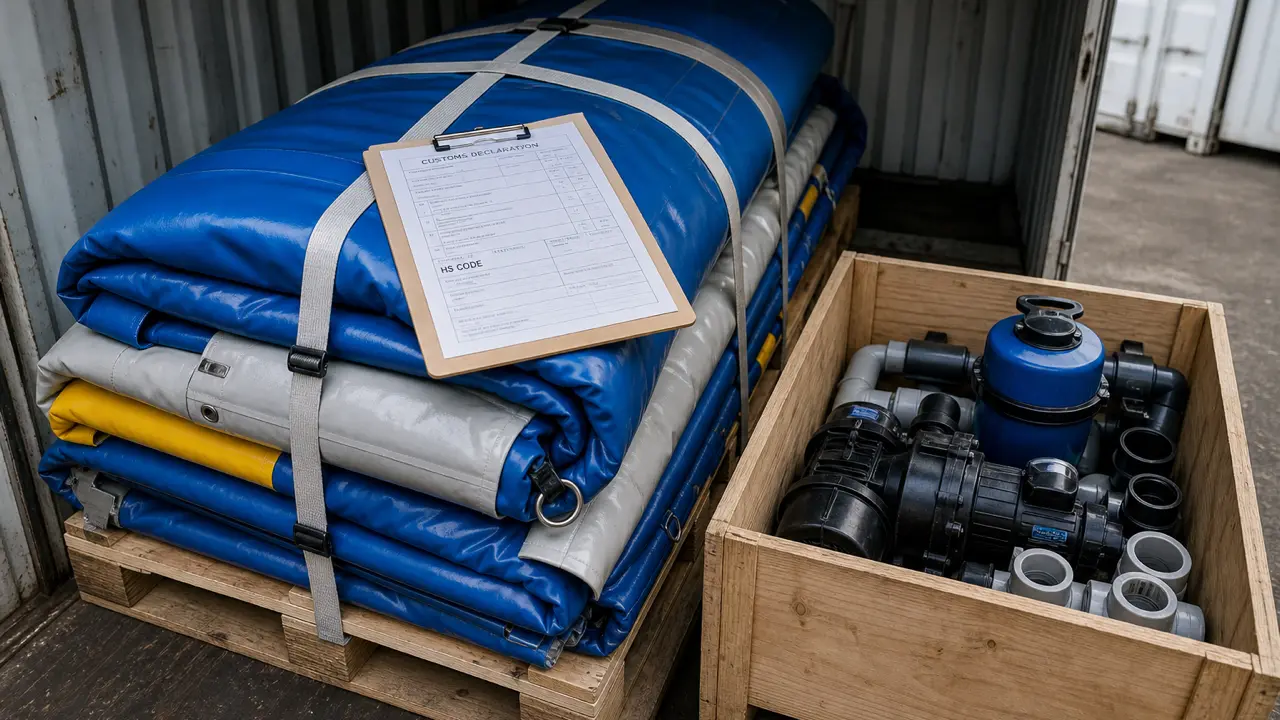
Water park modules and pools often ship as multi-component orders — the inflatable structure itself, plus a separate filtration pump, plumbing fittings, and sometimes a standalone blower. German customs classification questions most often arise from this bundling: declare the inflatable structure and its ancillary equipment (pumps, filters, fittings) clearly as separate line items with their own HS codes rather than folding everything under one general "inflatable" classification. A single vague declaration is the most common trigger for a customs hold and manual inspection at German ports.
For the broader EU-wide framework — CE marking, general HS code logic, and customs bond mechanics that apply across all EU member states including Germany — see the EU import guide for commercial inflatables. What's covered here is the water-product-specific layer on top of that general framework.
Once a water park module or commercial pool is installed in Germany, expect the operator (not just the importer) to need ongoing documentation: an installation record confirming anchoring and drainage match the manufacturer's specification, and — for larger public installations — the TÜV field certificate referenced above. Municipal event organizers and fairground associations commonly ask for this before granting a pitch or permit, similar to the equipment-inspection requirements seen across other German commercial attraction categories. Build the TÜV inspection step into your installation timeline rather than your import timeline — it happens after the unit is on-site and set up, not at the port.
Confirm with your factory that EN 14960 test documentation explicitly covers your product's water-contact use case — a certificate written for a dry bounce castle range doesn't automatically extend to a water slide or pool module with different anchoring and drainage requirements. Ask specifically whether the factory has prior export experience into Germany or the wider DACH region, since customs paperwork and inspection expectations differ meaningfully from other EU markets.
For the broader DACH regional sourcing picture — beyond water products, covering the full range of commercial inflatables sold into Germany, Austria, and Switzerland — see the DACH sourcing guide.
Budget roughly 6-8 weeks end-to-end for a water product entering Germany for the first time with a new factory relationship: EN 14960 documentation review and any gap testing, shipping and customs clearance, then TÜV field inspection scheduling after installation. Repeat orders from an already-vetted factory with existing German-market documentation move faster, since the certification chain doesn't need to be rebuilt from scratch. Cost planning should account for three separate line items rather than one bundled "certification fee": the factory's EN 14960 testing (often already priced into the unit if it's a standard product), the customs clearance and any broker fees, and the TÜV field inspection itself, which is billed separately by the inspection body based on installation size and complexity.
A water product entering Germany needs three things in order: EN 14960 documentation from the factory that explicitly covers water-contact use, a customs declaration that separates the inflatable structure from its ancillary equipment, and a TÜV field inspection scheduled into the installation timeline, not the shipping timeline. Get those three sequenced correctly and German import for water products is straightforward — buyers who skip the sequencing are the ones who get held up.
Browse the full water park modules category or the airtight pools category for current specifications.
For related buying considerations, see our German market event tent sourcing guide and our German and Austrian water park operators guide.