
Most sourcing content tells you how to evaluate a factory from the outside — what to ask, what documents to request, what red flags to watch for. This is the other half: what actually happens inside the factory between the day an order is confirmed and the day it leaves in a container, walked through on a real production timeline rather than a generic flowchart.
Every order — stock design or fully custom — starts with a CAD drawing confirmation before cutting begins, even for a design we've produced before, since dimensions, panel count, and seam layout need to match the buyer's exact spec (custom size, custom color blocking, or a themed shape). For custom artwork orders, this stage also includes digital proof approval; our custom-branded inflatables guide covers the artwork approval workflow in more detail, since it runs in parallel with structural spec confirmation rather than after it.
Once the CAD drawing is locked, PVC sheets are cut to the confirmed panel pattern — for a mid-size commercial unit this typically means 40-80 individual panels, each cut to a specific shape that will form the final structure's curves and seams. This is also where color-blocked and digitally printed panels get produced, since printing has to happen on flat cut panels before any welding starts, not after assembly.
Panels move to the welding line, where high-frequency welding fuses seams — the same process our factory-direct sourcing guide discusses when explaining why welded construction outperforms sewn-and-glued seams for commercial-duty equipment. Assembly follows a defined sequence: base panels first, then walls, then roof or turret sections, then reinforcement strips at every stress point (anchor loops, entry ramps, high-wear zones) — skipping the sequence is one of the most common corner-cuts a lower-quality producer takes to shave a few days off timeline, since reinforcement is far harder to retrofit once a structure is fully assembled.
Before a unit is approved for packing, it goes through a full inflation and pressure-hold test — typically a 24-hour hold to catch slow leaks that a quick visual inspection would miss — plus a seam-by-seam visual and physical inspection, and a blower functional test under full load. Units failing any check go back to the welding line rather than shipping with a noted defect, which is the main reason a rushed order timeline increases defect risk: skipping the hold-test window is the easiest place for a factory under deadline pressure to cut corners. Our manufacturing standards and export certification guide covers what documentation should back up this stage for buyers who want testing records in writing.
Blowers, repair kits, anchor stakes, and printed manuals get packed alongside the folded unit, and export documentation (packing list, commercial invoice, testing certificates if applicable) gets prepared in parallel rather than after packing completes, since documentation errors caught before container loading are far cheaper to fix than ones caught at destination customs.
Loading sequence matters more than most buyers realize — heavier accessory boxes go in first along the container floor, folded units get stacked and strapped to prevent shifting during transit, and a loading photo record gets taken for the buyer's reference before the container seals. This is also the stage our lead time breakdown guide references when explaining why the full 25-45 day window matters — a rushed final week is where transit-damage risk gets introduced through improper stacking or insufficient strapping.
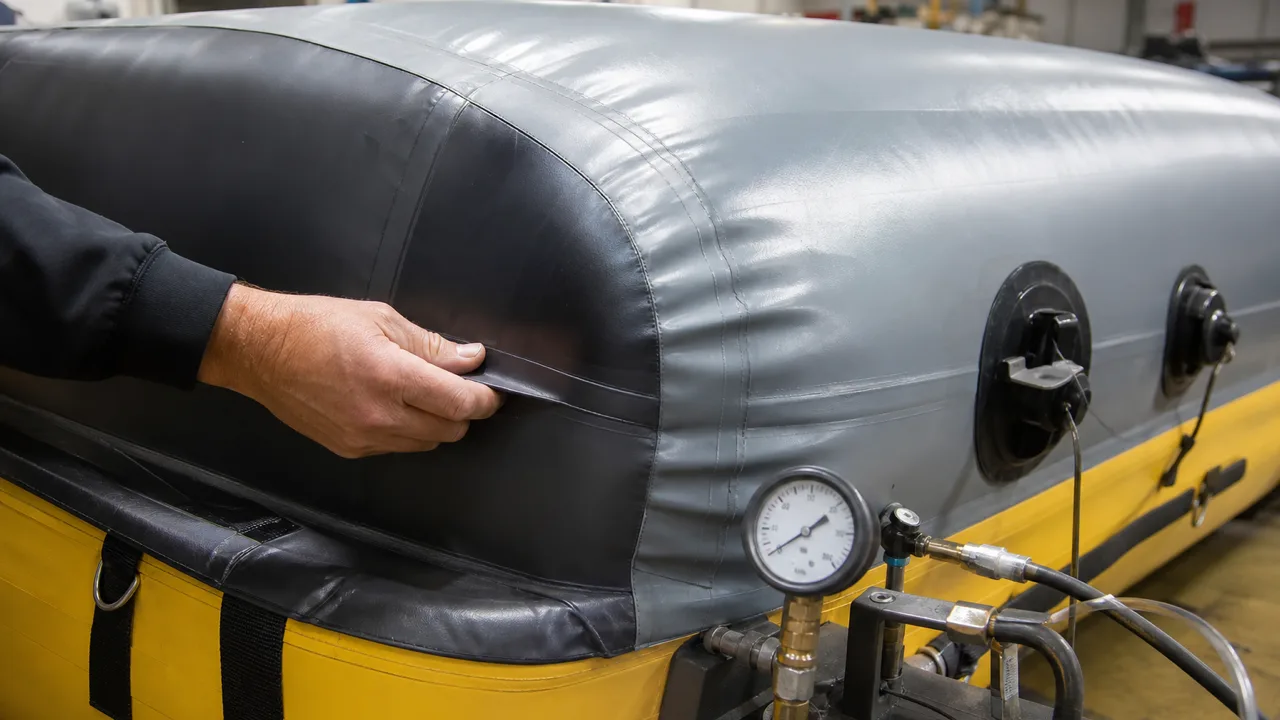
Why does pressure testing take a full 24 hours instead of a quick check?
A slow leak from a weak seam or valve often doesn't show up in a 10-minute inspection — it takes hours of sustained pressure to reveal, which is why a genuine 24-hour hold test catches defects a rushed check would miss.
Can this 35-day timeline be shortened for an urgent order?
Some stages can compress with expedited scheduling, but pressure testing and documentation prep are the two stages most factories won't cut, since skipping them is where defect and customs-delay risk actually gets introduced.
If you're evaluating a supplier and want to understand what a realistic production timeline should look like for your specific order, our team can walk through the stage-by-stage schedule for your spec.