
A vague RFQ gets a vague quote — not because a factory is being difficult, but because they have to guess at everything you didn't specify, and guesses get priced conservatively (or wrong). This is the checklist for writing an RFQ that comes back with an accurate, comparable quote on the first pass.
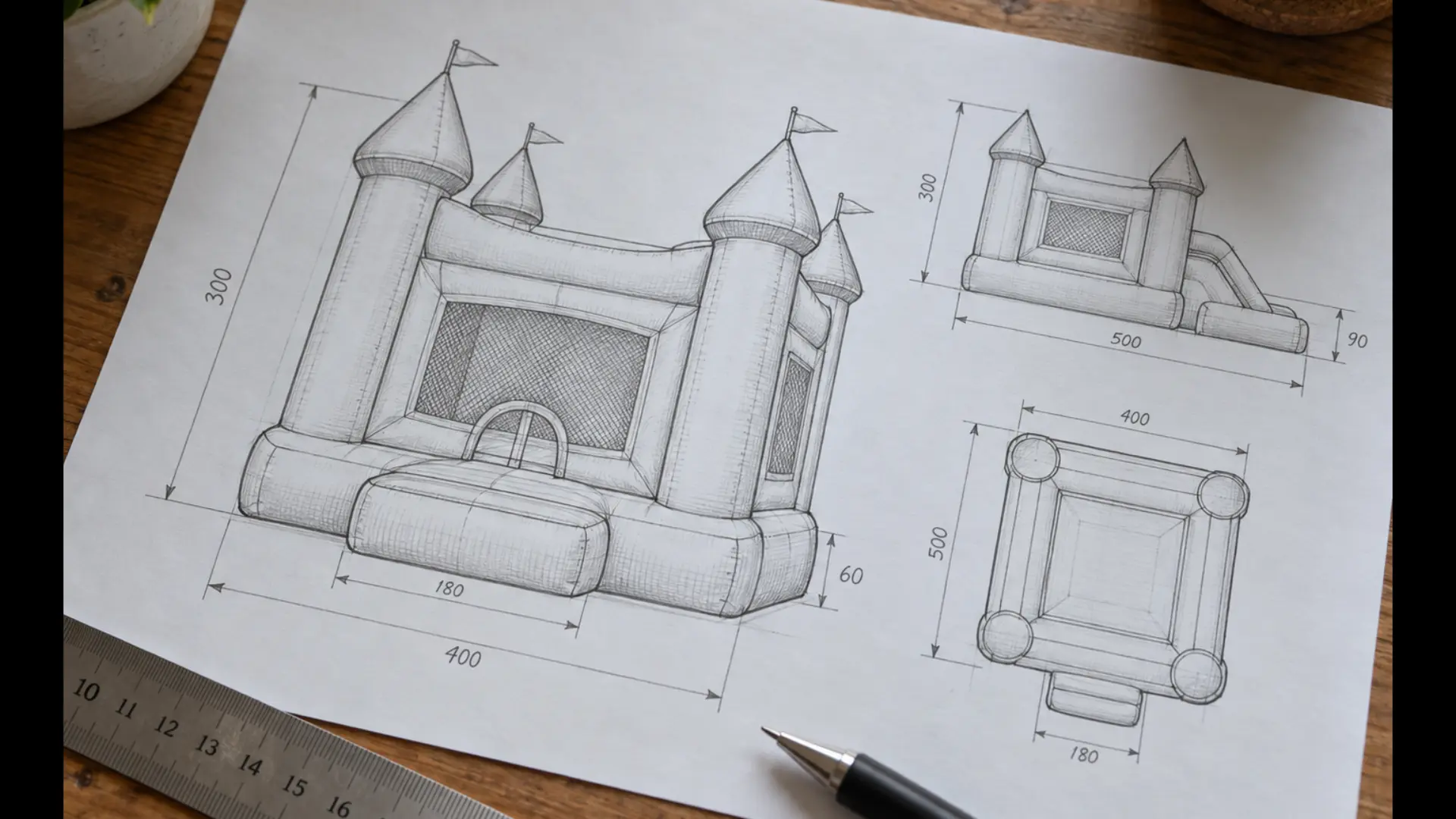
"A bounce castle" isn't a spec. Give exact footprint dimensions, height, and rated occupant capacity by age group. If you're working from a competitor's product listing or an existing unit you want matched or improved on, include that reference directly rather than describing it in words — a photo or spec sheet link removes ambiguity that a written description can't.
Specify PVC weight (g/m² or denier) if you have a target, or state the intended use case (daily commercial rental vs occasional event use) and let the factory recommend a grade — but don't leave it fully open if you have a minimum quality bar in mind, since "standard PVC" means different things at different factories. If you know whether you want welded or sewn seam construction, drop-stitch or traditional airtight, state it; if you don't know, say what durability and use-frequency you're targeting instead.
State the destination country or region explicitly, since certification requirements change by market — a factory quoting without knowing your target market can't confirm whether EN 14960, ASTM, or another standard applies, and a quote built around the wrong certification target is a quote you can't actually use. If you're importing into the EU specifically, mention it, since chemical compliance requirements like REACH sit alongside structural safety certification and are easy to leave out of a first RFQ.
State your target order quantity, and if you're testing a new design or ordering below typical minimums, say so upfront rather than having the factory discover it mid-negotiation. Our MOQ reality check by category gives a sense of realistic minimums before you submit, so your RFQ isn't built around an assumption that's off by an order of magnitude in either direction.
If the order includes custom printing or logo branding, specify the printing method if you have a preference, the surface area for artwork, and whether you have print-ready files ready or need design support — this affects both price and lead time significantly enough that leaving it out produces a quote that has to be revised once branding details surface later. See our artwork approval workflow guide for what a factory needs from you at the branding stage specifically.
A complete quote response should state lead time from deposit to ready-to-ship, payment terms, which certification documents are included versus available on request, and whether the price is FOB or CIF. A quote that answers only the unit price without these details isn't complete, and pushing for these specifics before committing is standard practice, not an imposition.
A quote that arrives within minutes for a fully custom, multi-spec RFQ is a sign no one actually read your specs closely. A factory that can't answer a direct question about certification documentation, or that quotes a price without confirming your target market's requirements, is worth treating as a lower-confidence source regardless of how competitive the number looks. This is a separate check from the initial supplier-vetting stage covered in our supplier vetting checklist — vetting confirms a factory is legitimate, while RFQ response quality confirms they actually engaged with your specific spec.
Log each factory's response against your original RFQ fields in a single sheet rather than comparing emails side by side — it makes gaps immediately visible (which factories didn't answer the certification question, which didn't confirm lead time) and turns the comparison from a subjective impression into a checklist match. This also gives you a paper trail if a factory's final invoice doesn't match what was quoted, since you have the original spec and their response documented in one place.
How much detail is too much detail for a first RFQ?
There's little downside to over-specifying on a first RFQ — a factory that receives more detail than it needs simply confirms what's already clear and asks about what's missing, while a factory receiving too little detail has to guess, and guesses are where inaccurate quotes come from.
Should I send the same RFQ to multiple factories at once?
Yes, sending an identical, fully-specified RFQ to several suppliers is the only way to get genuinely comparable quotes; varying the spec slightly between suppliers makes price comparison meaningless since you're no longer comparing quotes for the same product.
What if I don't know some of the technical specs yet?
State the outcome you're targeting (use case, budget range in terms of what you're solving for, target market) rather than leaving the field blank, and ask the factory to recommend a spec — a stated goal is far more useful to a factory than an empty field they have to guess at.
Ready to send a spec sheet? Submit your RFQ details through our quote form and we'll confirm every field before quoting, not after.