
This isn't a guide to maximizing how many units fit in a given container — our container loading capacity math guide covers that side of the calculation. This one starts from the other direction: you know how many units and what sizes you want to order, and need to work backward to which container size (or how many containers) actually fits that order.
A unit's inflated footprint tells you nothing about container space; what matters is its packed carry-bag dimensions and weight, which your supplier should provide per SKU. As a rough starting point, a standard mid-size bounce castle packs to roughly 1.2-1.5 cubic meters, a combo unit with a slide runs 1.8-2.5 cubic meters, and a full-size water slide can range from 3-5+ cubic meters packed, depending on length and construction. These are rough planning figures, not quotes — always confirm actual packed dimensions per SKU before finalizing a container decision.
A 20ft standard container holds roughly 28-33 cubic meters of usable cargo volume, and a 40ft HQ (high-cube) container holds roughly 68-76 cubic meters, though real-world usable volume runs 10-15% below theoretical maximum once you account for irregular shapes that don't stack perfectly. For a mixed order of primarily bounce castles and combo units, a 20ft container reasonably fits 15-20 units; a 40ft HQ reasonably fits 35-45 units of the same mix. Orders weighted toward large water slides fit fewer units per container by volume, even though the unit count sounds smaller than the container's theoretical capacity would suggest.
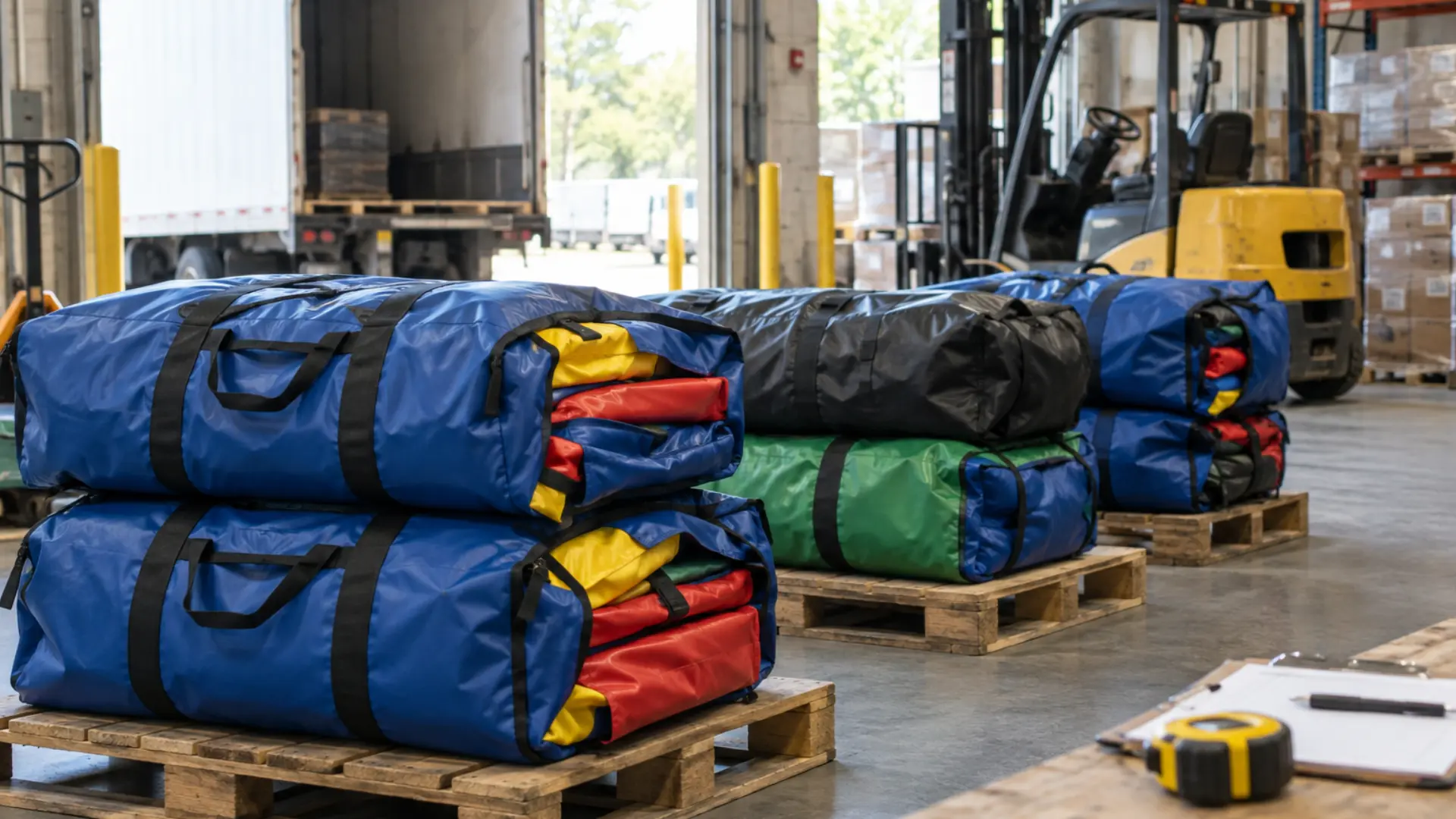
List your target quantity by SKU, multiply each by its packed cubic volume, and sum the total — then compare against the 85-90% realistic-usable-volume figure for each container size rather than the theoretical maximum. An order that comes out to 24 cubic meters fits comfortably in a 20ft container; an order between 30-60 cubic meters usually makes more sense as a single 40ft HQ than as an underfilled 20ft plus a small top-off shipment, both for cost-per-unit and for avoiding the added customs paperwork of a split shipment.
Standard containers have a maximum payload weight (roughly 28,000kg for a 20ft, 26,000-28,000kg for a 40ft HQ depending on carrier and route) that can become the binding constraint before volume does, particularly for heavier-gauge PVC units or orders with a lot of accessories like blowers, sandbags, and repair kits included. If your order runs toward heavier-duty commercial-grade material, check weight math alongside volume math rather than assuming volume is always the limiting factor. Buyers sourcing direct from the factory rather than through a domestic distributor should confirm packed weight figures as part of the process covered in our factory-direct sourcing guide, since weight documentation varies more between suppliers than volume estimates do.
A single-product order (all one SKU, same dimensions) packs more efficiently and predictably than a mixed order, since uniform boxes stack with less wasted space than an assortment of different-shaped packed units. If you're testing multiple products in one shipment, our wholesale pricing structure guide covers how mixed-SKU orders are typically priced relative to single-product bulk orders, since the container efficiency difference also shows up in per-unit freight cost.
If your target quantity lands just over a 20ft container's capacity, it's usually more cost-effective to either scale up slightly to better fill a 40ft HQ or trim the order down to fit the 20ft cleanly, rather than shipping a mostly-empty 40ft or paying for a second partial container. Our MOQ reality check by category is useful here too — adjusting quantity to better fit a container size sometimes also happens to align with a more favorable MOQ tier depending on the product category.
How much slack should I plan for beyond the calculated volume?
Plan for roughly 10-15% slack beyond your raw calculated volume to account for irregular packing shapes and accessories that don't stack as efficiently as the base units. Cutting it too close on paper often means the actual container doesn't close.
Is it worth ordering slightly more just to better fill a container?
Often yes, if the additional units are sellable inventory rather than dead stock — the marginal freight cost of filling unused container space with a few more units is usually lower than the per-unit freight cost of shipping a partially empty container.
Do accessories like blowers and repair kits need to be included in the volume calculation?
Yes — blowers, stakes, sandbags, and repair kits add both volume and weight, and are easy to forget in a quick mental estimate. Ask your supplier for a combined packed-volume figure per unit that includes standard accessories, not just the inflatable itself.
Share your target SKU list and quantities with our team, and we'll work the container math for your specific order rather than a generic estimate.