Few inflatable attractions pull a crowd like a zorb ball rolling across a field with a person laughing inside it. For rental operators and event companies, that visual is money: a transparent sphere is impossible to walk past, and the units turn over fast at fairs, festivals, corporate days, and holiday parks. The catch is that not all zorbing equipment is built to survive commercial use. This guide covers what actually matters when you source zorb balls and human hamster balls at wholesale for a rental or events fleet.
Buyers often lump everything under one name, but a commercial catalogue splits into three distinct products, each with its own venue and price logic.
The classic downhill unit: a large double-wall sphere with an inner capsule and harnesses, rolled down a gentle grass slope or run. This is the highest-thrill product and the one that needs the most site planning.
A single-chamber sealed ball floated on a pool or shallow water feature. Riders walk, run, and tumble on the surface. These are lower-risk, need a water setup, and are a strong fit for resorts, pools, and summer events.
The bubble soccer ball (a wearable half-body zorb with shoulder harnesses and handles) is the fastest-growing category. Low unit cost, high repeat play, and it works on any flat grass or turf pitch, which makes it the easiest zorbing product to add to a mixed commercial inflatable sports range.
Material is the single biggest quality variable in an inflatable rolling ball. Two options dominate.
TPU (thermoplastic polyurethane) is the premium choice for grass and water balls. It is highly transparent (crystal-clear, not yellow-tinted), stays flexible in cold weather, resists UV yellowing, and is far more abrasion-resistant on rough ground. A quality commercial zorb ball uses 0.8mm–1.0mm TPU for the outer wall.
PVC is cheaper and heavier, and it clouds and stiffens over time. It is acceptable for bubble soccer suits and budget units, but for a see-through rolling ball that lives outdoors, PVC ages badly. If you want the deeper trade-off between coating weights and grades, see our breakdown of PVC tarpaulin grades.
Grass and water zorbs use a double-layer inflatable structure: an outer ball and an inner capsule connected by hundreds of tension cords that suspend the rider and absorb shocks. Inspect the cord welds. This is where cheap units fail first.
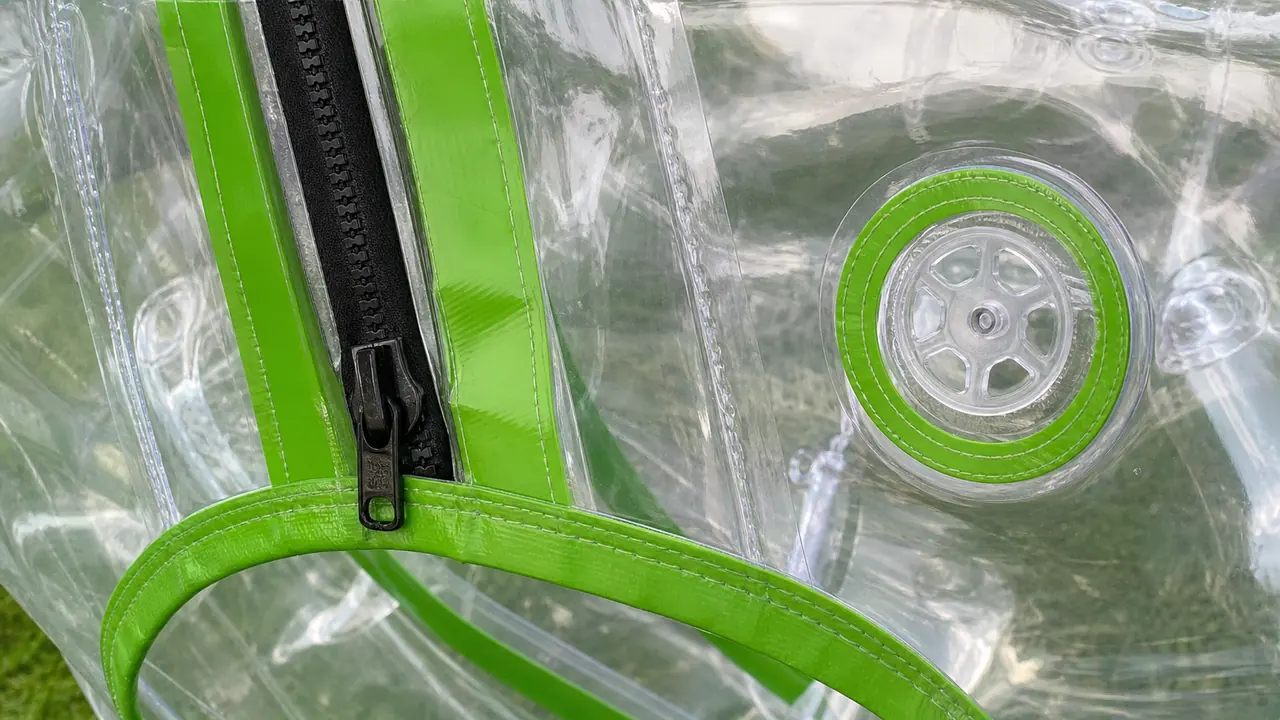
Zorbing equipment is only as safe as its detailing. Check three things on every sample.
Ventilation. Sealed balls need adequate airflow so riders can breathe during a run. Look for defined mesh-backed vent openings, and set ride-time limits in your operating procedure.
Entry and exit. A wide zip or overlap opening that an operator can open quickly matters for both loading and emergencies. The opening hardware should be robust and easy to reach from outside.
Site and slope. Grass balls need a groomed, obstacle-free run with side barriers and a flat run-out zone; never operate on hard ground. Water balls need a contained water feature and a spotter. Because zorbing shares the same operational discipline as other high-motion attractions, the safety and layout thinking in our inflatable obstacle course buyer's guide transfers directly.
Grass and water balls run roughly 2m to 3m in diameter. A 2m ball suits one rider (or a child); 2.5m–3m units take one to two adults. Bubble soccer suits come in kid and adult sizes and are bought in sets of 8–10 so you can field two teams. Match diameter to your rider profile and your run length before ordering.
Transparency is your selling point, so keep it. Rinse balls with mild soapy water after use, dry fully before storage to prevent mildew, and never fold TPU when it is cold or creases can set. Store deflated units out of direct sun. Keep a repair kit of matching TPU patches and adhesive on hand, and inspect vents, zips, and cord anchors before every event.
Most factories set a low MOQ on standard zorb balls, so a first order can be a small mixed pallet to test your market. OEM is straightforward: custom colours, printed logos on bubble suits, and branded carry bags are common on modest volumes. Lead times typically run a few weeks depending on TPU stock and print work.
For freight, zorb balls ship deflated and compress well, so they cube out efficiently. When you scale to a full fleet, plan the load in advance. Our comparison of 20ft vs 40ft HQ container loading shows how to consolidate a mixed inflatable order into a single 40ft HQ and cut per-unit freight. If you are building a fleet from scratch, our guide to starting an inflatable rental business covers how zorbing fits into a wider rental lineup.
A zorb ball is a high-visibility, high-turnover rental asset. The purchase decision comes down to a few controllables: choose TPU over PVC for clear, durable rolling and water balls, verify ventilation and entry design, confirm the double-wall cord construction, and size the units to your riders and site. Get those right and the human hamster ball pays for itself fast.