
An inflatable stunt airbag is not a novelty product. It is safety-critical equipment that stands between a performer or athlete and a hard landing. When a stunt team drops a stunt double from a rig, when a freerunner overshoots a wall, or when a gymnast lands short off the vault, the airbag has one job: absorb kinetic energy and decelerate the body without injury. For buyers sourcing these units for film sets, action-sports venues, parkour gyms, and training facilities, the purchasing decision has to center on cushioning design, material strength, and validated landing performance — not on price per square meter.
This guide walks through the main product categories, how deceleration structures actually work, what materials to specify, and the practical realities of sizing, certification, and shipping.
Buyers often use "stunt airbag" as a catch-all, but the products serve distinct use cases and are engineered differently.
These are the large, deep units used on film sets and for high-fall training. A freefall airbag is built to catch a body dropping from significant height, so depth and internal air management matter more than surface area. The deeper the bag and the more controlled the air release, the longer the deceleration stroke.
For BMX, freestyle ski, snowboard, and mountain-bike jump progression, an inflatable landing mat gives athletes a forgiving surface to practice new tricks before committing to a hard landing. These are typically wide, ramped or wedge-shaped, and sized to the takeoff geometry of the jump.
A gymnastics air track is a long, low-pressure inflatable strip used for tumbling passes, cheer, and martial-arts training. Built on drop-stitch technology, it holds a firm, consistent surface at controlled pressure and rolls up for storage.
The big airbag jump format — a large, angled catch bag at the base of a ramp or platform — bridges recreation and training. It is popular at action parks and camps, and the same deceleration principles apply as with a professional stunt landing airbag.
Many of these units sit within a broader commercial inflatable sports range, so buyers stocking multiple disciplines can standardize on one supplier and one material spec.
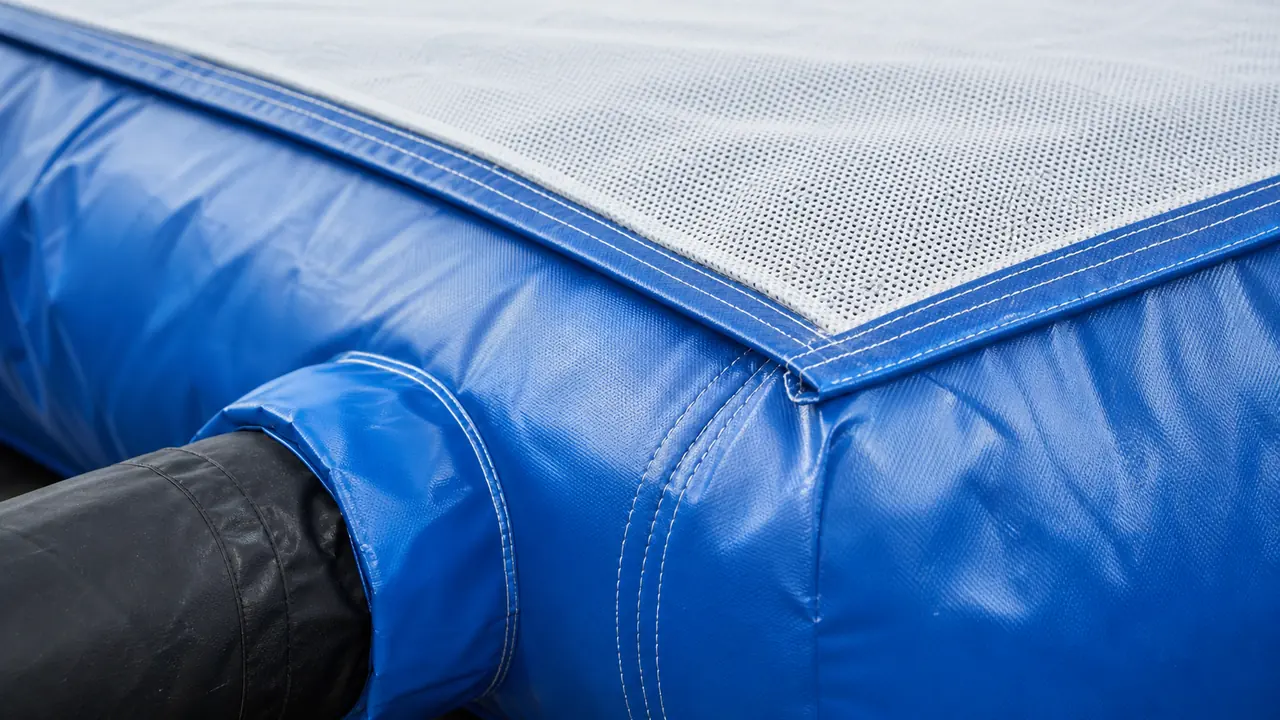
The physics of a safe landing is simple to state and hard to engineer: you have to bring the body to rest over the longest possible distance and time. A short, hard stop transfers force into the body; a long, progressive stop spreads it out. Landing airbags achieve this in two main ways.
Constant-air (vented) designs run a blower continuously and rely on controlled air escape. On impact, air is forced out through calibrated vents or a permeable top surface, so the body sinks into the bag as air bleeds away — a long deceleration stroke. The blower then re-inflates the unit for the next jump. This is the dominant approach for freefall and big-jump units because the vent design lets engineers tune how "soft" or "supportive" the landing feels.
Airtight (sealed) designs hold a fixed volume of air with no blower running during use. These give a firmer, more predictable surface — good for air tracks and thinner landing mats — but the cushioning stroke is shorter, so they suit lower-energy landings. The trade-offs between the two are worth understanding before you buy; our breakdown of airtight vs constant-air construction covers where each belongs.
Material is where a safety-critical airbag is won or lost. Reputable units use high-strength PVC tarpaulin, typically in heavier weights for high-stress landing surfaces and reinforced at seams and stress points. Weight, coating, and weave all affect tear resistance and service life — the differences between PVC tarpaulin grades are not cosmetic, and specifying too light a fabric on a landing surface is a false economy.
For rigid-feeling surfaces like air tracks and some landing mats, drop-stitch construction is the standard. Thousands of internal threads connect the top and bottom skins, so the panel holds a flat, firm shape under pressure instead of ballooning. If you are evaluating air tracks or firm mats, it is worth understanding how drop-stitch inflatable construction delivers that stiffness without adding weight.
This is the part buyers must not shortcut. The maximum safe landing height, the rated impact energy, and the load capacity of an airbag depend entirely on the specific model and its engineering — they are not universal figures. Any supplier that quotes a single "safe from X meters" number for all units, without reference to model, is a warning sign. Always source these values from the manufacturer's rated specification for the exact unit, and match the unit to your intended fall height with margin.
Look for manufacturing to recognized standards, documented material certificates, reinforced blower and vent systems on constant-air units, and clear guidance on maximum user load and simultaneous users. For film and professional training use, insist on documentation you can hand to a safety officer or insurer. Treat rated landing height and weight capacity as manufacturer-rated values to be verified for your model, never as numbers to estimate on your own.
Size follows use case. Freefall bags are specified by fall height and footprint; landing mats by the takeoff geometry they serve; air tracks by length and thickness for the discipline. Load capacity — both total weight and number of simultaneous users — again comes from the model's rating. The practical buyer's approach is to define the highest fall height and heaviest user you need to protect, then have the supplier confirm the unit is rated for that case with headroom, rather than working backward from a stock size.
Operationally, constant-air units inflate in minutes with the right blower and deflate fast for repositioning between takes or sessions. Air tracks and mats roll into carry bags for transport and storage. For international buyers, folded shipping volume drives freight cost: a full set of mats and bags packs down for FOB or CIF ocean freight, and how efficiently the order fills a container matters — our notes on 20ft vs 40ft HQ container loading help you plan volume. A single 40ft HQ can consolidate a mixed order of stunt bags, mats, and air tracks.
Sourcing direct from the factory gives you control over material grade, dimensions, vent design, and branding. MOQ on standard configurations is usually low, and OEM service lets you specify custom sizes, colors, logos, and reinforced landing zones for your discipline. The value case is straightforward: safety-critical equipment sourced to the right spec lasts longer, protects your people, and reduces liability — a far better return than saving a few dollars on lighter fabric.